

Learn simple, practical steps to start speaking English confidently as a beginner—at home or in class.

Need this page in your language? Use Google Translate
Guess what? When you click and buy through our links, you’re doing more than improving your game. You’re supporting us in a way that doesn’t cost you extra but helps us keep bringing you the best drills and tips. It’s a slam dunk for both of us!
If you are a beginner, you may feel nervous about speaking English.
That is normal.
Many adult learners think:
“My grammar is not good.”
“My pronunciation is not clear.”
“I am afraid to make mistakes.”
Here is the truth:
You do not need perfect grammar to start speaking.
You need practice.
This guide will show you how to begin safely, confidently, and practically — whether you are in a classroom or studying at home.
In This Lesson You Will Learn:
- Why beginners feel afraid to speak
- The safest way to start speaking
- Simple sentences to practice first
- A 5-minute daily speaking routine
- How to grow to the next level
How Can Beginners Start Speaking English Without Fear?
Beginners can start speaking English without fear by using short sentences, practicing familiar topics, listening before speaking, and repeating daily. Confidence grows from small, consistent practice — not perfection.
Why Are Beginners Afraid to Speak English?
Most beginners are afraid because:
- They don’t want to make mistakes.
- They compare themselves to stronger students.
- They translate in their head before speaking.
- They think speaking must be perfect.
In reality, speaking improves because of mistakes.
Mistakes show effort.
Effort creates growth.
If you wait to feel “ready,” you will wait too long.
I tell my students all the time to not be afraid to make mistakes.
The best way to learn anything, especially a language is by doing. You must practice what you learn if you truly want to learn.
Making mistakes is part of the learning process. We learn from our mistakes. Yes, making mistakes can be embarrassing but, for me, if I embarrass myself, I usually only embarrass myself the same way once.
Chances are, probably the real fear is, you’re worried what other people think of you.
What other people think of you does not need to be your problem.
What Is the Safest Way to Start Speaking?
Start small.
- Use short sentences.
- Speak about familiar topics.
- Repeat what you hear.
- Practice daily.
This method works in class and at home.
In class: Speak during warm-up.
Answer simple questions.
Repeat model sentences.
At home: Describe your day.
Talk about your job.
Explain your routine.
Simple is powerful.
What Sentences Should Beginners Practice First?
Start with real-life topics.
| Topic | Simple Sentence | Expanded Version |
|---|---|---|
| Morning | I wake up at 6. | I wake up at 6 and drink coffee. |
| Work | I work at a store. | I work at a grocery store near my house. |
| Family | I have two children. | I have two children, a boy and a girl. |
| Location | I live in Covina. | I live in Covina near the park. |
Notice something important:
The expanded version is only one step higher.
That is how improvement happens.
Small expansion.
Not big jumps.
What Is a Simple 5-Minute Daily Speaking Routine?
You do not need one hour.
You need structure.
Try this:
Minute 1
Speak about today.
Minute 2
Repeat it and improve one sentence.
Minute 3
Listen to short English audio and repeat.
Minute 4–5
Write two sentences and say them out loud.
That is it.
Five minutes.
Every day.
Progress.
If you want guided speaking practice, you can work with a live tutor on italki:
https://www.italki.com/affshare?ref=af26596988
Structured beginner programs like Rocket Languages can also support daily speaking practice:
https://f0b91ha8qrkjpi5d26v748ilru.hop.clickbank.net/
You can also explore beginner listening and speaking lessons at EnglishClass101:
https://www.englishclass101.com/member/go.php?r=4904301&l=%2F
For additional vocabulary and conversation practice tools, try Mondly Languages:
https://www.kqzyfj.com/click-100992175-14103335
The key is consistency.
Listening Practice
Read this short dialogue:
A: Where do you work?
B: I work at a restaurant.
A: What do you do there?
B: I am a cook.
Now:
Read it.
Say it.
Change it.
Example:
“I work at a hospital.”
“I am a nurse.”
Practice makes it natural.
Beginner Speaking Formula
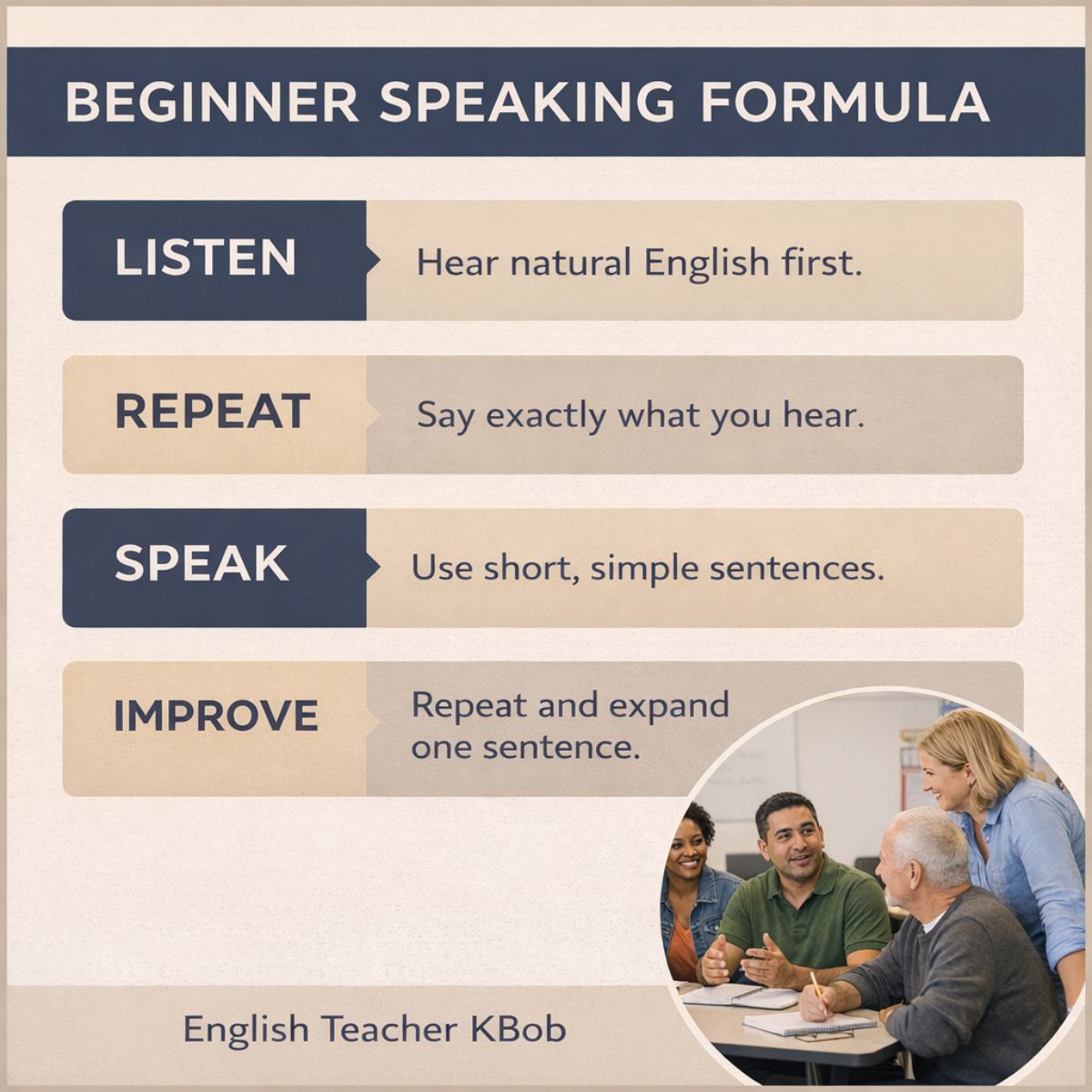
Free Mini Speaking Worksheet (Sample)
Practice:
- I wake up at ______.
- I work at ______.
- I live in ______.
- I have ______.
Speaking Prompts:
- Describe your morning.
- Describe your job.
- Describe your family.
Rewrite the dialogue using your information.
For a full expanded beginner speaking lesson with structured activities and role-play, visit The KBob Teacher Toolbox on Teachers Pay Teachers:
https://www.teacherspayteachers.com/store/the-kbob-teacher-toolbox
What Is the Next Level After Beginner?
When you feel comfortable speaking short sentences, the next step is learning how to connect them.
Example:
Beginner:
I wake up at 6.
Next level:
First, I wake up at 6. Then I drink coffee. After that, I go to work.
You do not stay a beginner forever.
You build one step at a time.
We will explore how to build full conversations in future lessons.
Final Thoughts
You do not need to feel ready to speak.
You need to start.
Small sentences.
Daily practice.
Consistent effort.
What Do You Think?
What is the most difficult part of speaking English for you?
Was this article helpful for you? Did you learn anything from it?
Tell me what you think. I’d love to hear from you.
Share your answer in the comments.
I always reply.
Keep going.
You are building something real.
— English Teacher KBob
#AdultESL, #LearnEnglish, #EnglishSpeaking
Thank you so much for this post, Bob! As a Hispanic speaker, I think one of our biggest hurdles is the fear of making mistakes or having a strong accent. We often wait for ‘perfection’ before we open our mouths, but your advice about starting at home is a game-changer.
Thanks for your comments Leah. I’m glad you like the article. I can’t teach confidence but I can and do encourage people to do what it takes to find it for themselves.
Hi Leah, thanks for your comments. I’m glad you like the article. I can’t teach confidence but I can and do encourage people to do what it takes to find it.
KBob
This is a really practical guide, especially for adult learners who may feel self-conscious about speaking a new language. I liked the emphasis on starting with simple sentences and building confidence through daily practice. That approach makes a lot of sense because language learning, like most skills, improves through repetition and consistency rather than trying to master everything at once.
Your point about not waiting until you feel “ready” to speak is also important. In my experience, people often hold themselves back because they are afraid of making mistakes or being judged, but mistakes are actually part of the learning process. The only way to get comfortable speaking is by actually speaking.
I also think the 5-minute daily routine is a great idea. Many people believe they need long study sessions to improve, but short, structured practice every day can be much more effective over time.
Hi Jason, thanks for your comments. I’m glad you can relate.
KBob