

Learn how to pronounce the letter I in English, including short I, long I, –ing, oi, and when I sounds like E in real spoken English.

Guess what? When you click and buy through our links, you’re doing more than improving your game. You’re supporting us in a way that doesn’t cost you extra but helps us keep bringing you the best drills and tips. It’s a slam dunk for both of us!
English learners are often surprised by how many different sounds the letter I can make in English. Sometimes it sounds short, sometimes it sounds long, and sometimes it changes inside word endings like –ing.
To make things even more confusing, many native English speakers don’t always pronounce these sounds the same way in everyday conversation.
In this lesson, we’ll slow everything down and make the pronunciation of I i clear, practical, and usable in real life.
What You’ll Learn in This Lesson
- The short I sound and how to pronounce it
- The long I sound and common spelling patterns
- How silent E changes the sound of I
- How –ing is pronounced and why it’s used
- Why many Americans drop the g in –ing when they speak
- How oi /ɔɪ/ is pronounced in English
- When the letter I sounds like long E /iː/ in words like machine
Table of Contents
- How do you pronounce the letter I in English?
- What is the short I sound?
- What is the long I sound?
- How does silent E affect the letter I?
- How is –ing pronounced in English?
- How is oi pronounced in English?
- When does the letter I sound like long E?
- Practice activities and examples
How do you pronounce the letter I in English?
The letter I has two main vowel sounds in English: the short I /ɪ/ and the long I /aɪ/. In addition, when I appears in the –ing ending, it almost always uses the short I sound. Understanding which sound to use—and when pronunciation changes in casual speech—will improve both your speaking and listening skills.
What is the short I sound?
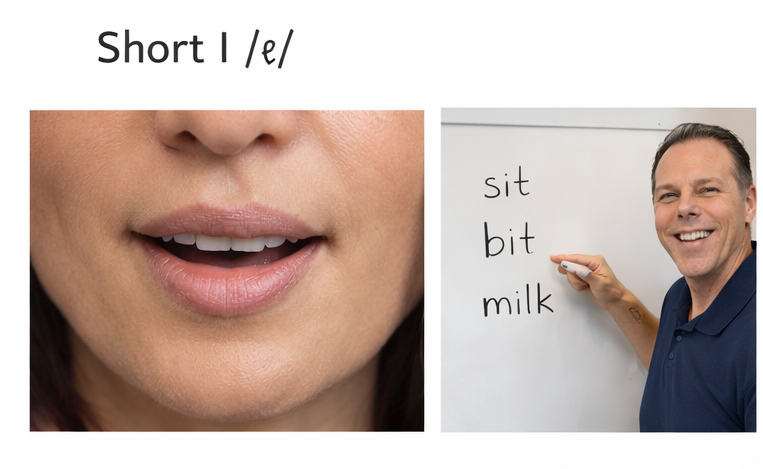
The short I sound is written in phonics as /ɪ/. It is a quick, relaxed sound.
Mouth position:
- Mouth slightly open
- Tongue relaxed and forward
- No long movement
Common examples:
- sit
- bit
- ship
- milk
- listen
Example sentence:
- I sit with my sister.
A helpful rule: if the sound feels stretched or tense, it is probably not a short I.
What is the long I sound?
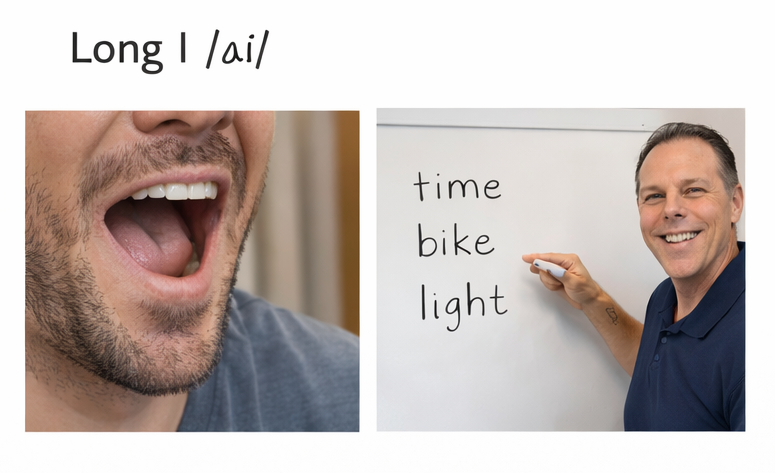
The long I sound is written as /aɪ/. This is a diphthong, which means two vowel sounds glide together.
Mouth movement:
- Start with the mouth open
- End with the mouth more closed
Common spelling patterns:
- i (time)
- i_e (bike)
- igh (light)
- y (my)
Example sentence:
- I ride my bike at night.
If your mouth does not move, you are not pronouncing the long I correctly.
How does silent E affect the letter I?
When a word ends in silent E, the vowel before it usually becomes long.
Examples:
- kit → kite
- rid → ride
- dim → dime
Simple rule: Silent E makes the vowel say its name (most of the time-not always).
How is oi pronounced in English?
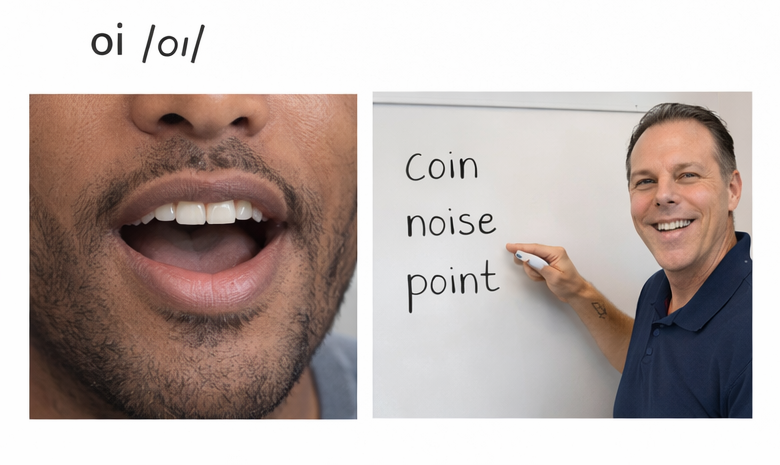
The oi spelling makes a diphthong sound written as /ɔɪ/. This sound starts with rounded lips and moves quickly to a short I sound.
Mouth movement:
- Start with rounded lips (like aw)
- Glide to a relaxed short I sound
Common examples:
- coin
- oil
- noise
- point
- voice
Example sentence:
- I hear a loud noise in the kitchen.
This sound is very consistent in English, which makes it easier to recognize once you learn it.
When does the letter I sound like long E?
In some English words—often longer or borrowed words—the letter I sounds like the long E /iː/ instead of a short or long I.
This pronunciation is common in words with French or international origins.
Common examples:
- machine
- magazine
- police
- routine
Example sentence:
- I read a magazine about new machines.
Important note: This sound must be learned by exposure and practice. There is no simple spelling rule, so listening is key.
How is –ing pronounced in English?
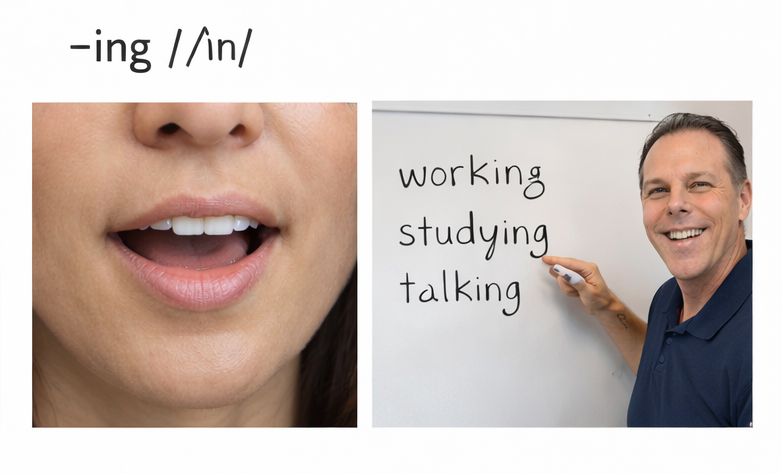
The –ing ending is extremely common in English. It is used in:
- The present continuous tense (I am working)
- Gerunds (verbs used as nouns) (Learning English is fun)
Correct pronunciation of –ing
In standard English, –ing is pronounced /ɪŋ/.
- The vowel sound is the short I
- The final sound is ŋ (the back-of-the-tongue sound)
- The g is not pronounced as a hard “g”
Examples:
- working
- talking
- studying
Why do people say “workin’” instead of “working”?
In everyday, informal speech, many English-speaking Americans drop the g sound in –ing words. This is a natural speech reduction, not a mistake.
Examples:
- working → workin’
- talking → talkin’
- going → goin’
Important notes for learners
- This pronunciation is very common in casual conversation
- It is not appropriate for formal speaking
- ESL learners should first master the full –ing pronunciation before copying casual speech
Use full –ing pronunciation when:
- Speaking in class
- Giving presentations
- Job interviews
- Recording audio or video
Sound Comparison Table
| Pattern | Pronunciation | Example | Notes |
|---|---|---|---|
| Short I | /ɪ/ | sit | Short, relaxed sound |
| Long I | /aɪ/ | time | Mouth moves |
| –ing | /ɪŋ/ | working | Often reduced in casual speech |
| oi | /ɔɪ/ | coin | Strong diphthong |
| i = long E | /iː/ | machine | Common in borrowed words |
——|————-|——–|——| | Short I | /ɪ/ | sit | Short, relaxed sound | | Long I | /aɪ/ | time | Mouth moves | | –ing | /ɪŋ/ | working | Often reduced in casual speech |
Practice: Say It Aloud
Short I: sit, bit, fish, milk
Long I: time, five, light, my
–ing: working, studying, listening
Minimal pairs
- sit / site
- bit / bite
- working / workin’
Free Practice Worksheet
Download a free pronunciation worksheet to practice:
- Short I vs Long I
- –ing pronunciation
- Sentence correction activities
This sample worksheet leads directly into the full pronunciation lesson available in the KBob Teacher Toolbox on Teachers Pay Teachers.
Final Thoughts
English pronunciation isn’t just about rules—it’s about understanding how English is actually spoken. By learning the short I, long I, silent E, and –ing pronunciation, you’ll be better prepared to understand native speakers and speak more clearly yourself.
What do you think? Which sound is hardest for you—the short I, the long I, or –ing?
Leave comments and questions in the space below. I always reply.
ESLPronunciation,#LearnEnglish,#EnglishVowels,#SpokenEnglish,#AdultESL,#EnglishListening,#EnglishSpeaking
This is a really clear and well-structured lesson—perfect for adult ESL learners. ???? I love how you break down mouth position and movement, especially for short I vs long I, and the explanation of –ing vs “workin’” is super practical for real-life listening. The sound comparison table and minimal pairs make this very teachable, not just readable. A great balance of rules, real spoken English, and learner-friendly guidance.
Hi Monica, welcome back. Thanks again for your comments. I try to go above and beyond normal teaching methods to make sure people truly understand.
KBob
This is a very clear and learner-friendly explanation of one of the most confusing areas of English pronunciation. You’ve done an excellent job breaking down the multiple sounds of the letter I in a way that feels structured, practical, and approachable especially for learners who may feel overwhelmed by inconsistent pronunciation rules.
The section on –ing pronunciation is especially strong. Explaining the difference between standard pronunciation and natural speech reduction while clearly advising learners when not to drop the g is a great example of teaching real-world English responsibly. Many learners struggle because they imitate casual speech too early, and your guidance helps prevent that confusion.
Overall, this is a well-organized and practical resource that supports both speaking confidence and listening comprehension. Learners following this lesson will come away with a much clearer understanding of how English is spoken not just how it’s written.
Hi Kavitha, thanks for your comments. I hope you’re right. The content is supposed to be helpful.
KBob