

Learn simple English speaking patterns so you always know what to say in conversations. Perfect for adult ESL learners.

Use Google Translate: https://translate.google.com/
Guess what? When you click and buy through our links, you’re doing more than improving your game. You’re supporting us in a way that doesn’t cost you extra but helps us keep bringing you the best drills and tips. It’s a slam dunk for both of us!
Many adult English learners want to speak, but they do not know what to say.
They understand words. They understand grammar. But when it is time to speak, their mind goes blank.
Why does this happen?
In this lesson, you will learn simple speaking patterns that help you know what to say in English conversations.
If you want extra speaking practice with real teachers, you can try it here: https://www.italki.com/affshare?ref=af26596988
Summary: • Many learners do not speak because they lack structure • Speaking patterns make communication easier • Simple repetition builds confidence • Daily practice helps you remember what to say
Table of Contents:
- Why Don’t Students Know What to Say?
- What Are Speaking Patterns?
- What Are the Most Useful Speaking Patterns?
- How Can You Practice These Patterns?
Why Don’t Students Know What to Say?
Many adult ESL students try to create sentences from nothing.
This is difficult.
Instead of using structure, they try to remember many different words and rules at the same time.
This creates stress and confusion.
The solution is to use patterns.
What Are Speaking Patterns?
Here is a simple visual to help you understand these speaking patterns:
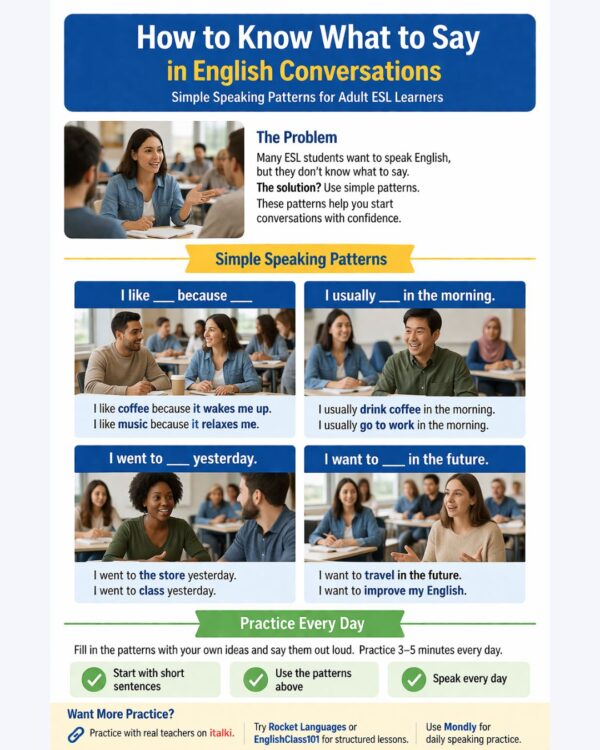
Now let’s look at some simple patterns you can start using today.
Speaking patterns are simple sentence structures that you can use again and again.
They help you organize your thoughts quickly.
You do not need to think about grammar every time.
You just follow the pattern.
You can also practice these patterns with structured programs like Rocket Languages and EnglishClass101: https://f0b91ha8qrkjpi5d26v748ilru.hop.clickbank.net/ https://www.englishclass101.com/member/go.php?r=4904301&l=%2F
What Are the Most Useful Speaking Patterns?
Here are four simple patterns you can use every day:
- I like ___ because ___ Example: I like coffee because it gives me energy.
- I usually ___ in the morning Example: I usually drink coffee in the morning.
- I went to ___ yesterday Example: I went to the store yesterday.
- I want to ___ in the future Example: I want to learn English in the future.
These patterns help you speak about your life.
How Can You Practice These Patterns?
You can practice these patterns every day.
Try this:
• Say each pattern out loud • Create your own sentences • Repeat your sentences • Write your sentences
Apps like Mondly can also help you practice daily speaking: https://www.kqzyfj.com/click-100992175-14103335
Practice Worksheet (Sample)
Download a simple speaking worksheet here:
For full lessons and activities, visit The KBob Teacher Toolbox: https://www.teacherspayteachers.com/store/the-kbob-teacher-toolbox
Final Thoughts
If you want to speak English, you need structure.
Speaking patterns help you know what to say.
Do not wait.
Start using these patterns today.
What do you think?
Which pattern is easiest for you?
Write your answer in the comments. I’d love to hear from you. I always reply.
Call to Action
If you are serious about improving your English, you can start with these platforms:
• italki (live speaking practice): https://www.italki.com/affshare?ref=af26596988
• Rocket Languages (structured lessons): https://f0b91ha8qrkjpi5d26v748ilru.hop.clickbank.net/
• EnglishClass101 (audio and video lessons): https://www.englishclass101.com/member/go.php?r=4904301&l=%2F
• Mondly (daily practice app): https://www.kqzyfj.com/click-100992175-14103335
Keep practicing. Keep improving.
learnenglish, #eslspeaking, #englishpractice, #speakenglish, #adultlearners, #englishconversation, #eslteacher, #learnenglishonline
This is exactly what I need for my mom! She’s trying so hard to learn, but she often freezes up during conversations. These simple speaking patterns are the perfect ‘scripts’ to help her build confidence without worrying about perfect grammar.
I’m going to print these out to practice with her at the dinner table. Thank you for making this so accessible for adult learners! ????
Hi Leah, thanks for your comments. I’m glad this lesson will help your mother. There are lots of lessons for adult English learners. I hope your mother will have a look for herself.
KBob
This is a really solid, practical post. I like how you focused on structure over overwhelm—that’s honestly where a lot of adult learners get stuck.
The idea that people “go blank” even when they understand grammar is so real. I’ve seen that happen a lot. It’s not usually a knowledge problem, it’s a confidence and structure problem. Giving simple patterns like “I like ___ because ___” is powerful because it removes that pressure to build sentences from scratch.
I also think you nailed something important that doesn’t get talked about enough: repetition. A lot of people want to “learn more” instead of just using what they already know. Those basic patterns, repeated daily, can actually take someone pretty far in real conversations.
If I had one thought to add, it might be this, real-life context helps a ton too. Once someone gets comfortable with these patterns, using them in actual conversations (even simple ones) is where things really start to click.
Overall, this is super beginner-friendly and actionable. The “start simple and repeat” approach is exactly what most adult learners need.
I’d be curious—do you find students struggle more with starting a sentence or continuing one once they begin?
Hi Jason, thanks for your comments. I try to as much as possible, use real-life examples, using either myself or the students or both as subjects, whether it’s something simple or more complicated. I’m a firm believe that when students can connect learning to their real lives, it’s much more meaningful.
As for your question, I find students struggle more with keeping a conversation going. The basic starting points are often somewhat predictable but there are too many variables after that and that’s when they get lost, although it’s also where and how they learn.
KBob