

Learn how to pronounce the letter U in English with simple examples and practice activities for adult ESL learners.

Guess what? When you click and buy through our links, you’re doing more than improving your game. You’re supporting us in a way that doesn’t cost you extra but helps us keep bringing you the best drills and tips. It’s a slam dunk for both of us!
Many English learners are confused by the letter U.
Sometimes it sounds short. Sometimes it sounds long. Sometimes it changes depending on the word.
In this lesson, you will learn the most common U sounds and how to practice them step by step.
If you want extra pronunciation practice with a real teacher, you can try it here: https://www.italki.com/affshare?ref=af26596988
Summary: • The letter U has multiple sounds • Short U and Long U are the most important • U changes depending on spelling and word patterns • Practice helps you hear and produce correct sounds
Table of Contents:
- What Are the Main Sounds of U?
- What Is the Short U Sound?
- What Is the Long U Sound?
- What Are Other Common U Sounds?
- How Can You Practice U Sounds?
What Are the Main Sounds of U?
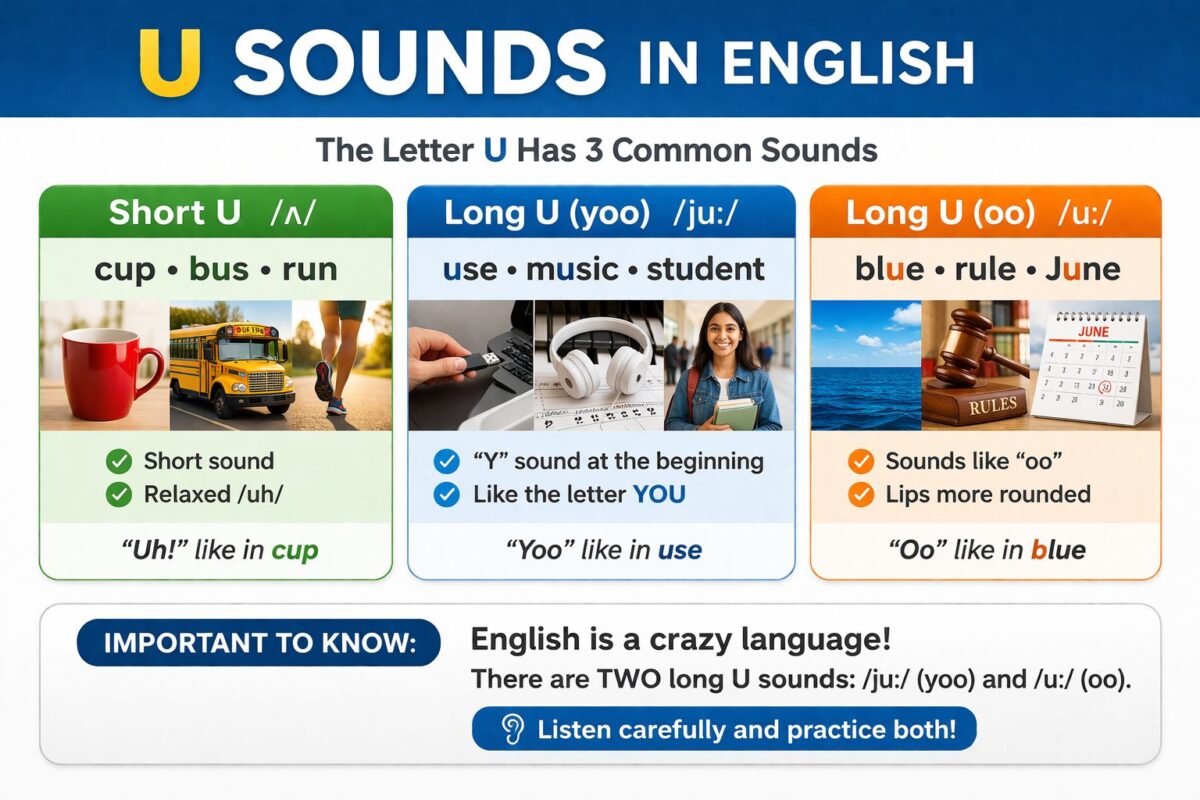
Important Note (Rule #1 – English is a crazy language):
A silent e at the end of a word often changes the vowel sound—but not always.
Examples:
cut → cute
us → use
This is a helpful pattern, but English has many exceptions.
The main sounds of U are:
• Short U • Long U (yoo sound) • Long U (oo sound)
What Is the Short U Sound?
The short U sound is /ʌ/.
Examples:
cup run bus sun
This sound is relaxed and short.
What Is the Long U Sound?
There are TWO long U sounds.
1. /juː/ (yoo sound)
Examples:
use music student university
You hear a “y” sound at the beginning.
2. /uː/ (oo sound)
Examples:
blue true rule June
This sounds like the “oo” in food.
You can also practice with structured programs like Rocket Languages or EnglishClass101: https://f0b91ha8qrkjpi5d26v748ilru.hop.clickbank.net/ https://www.englishclass101.com/member/go.php?r=4904301&l=%2F
What Are Other Common U Sounds?
Sometimes U changes depending on the word.
Examples:
put (/ʊ/) full (/ʊ/)
These are exceptions and must be practiced.
How Can You Practice U Sounds?
Try this simple routine:
• Say each word out loud • Repeat 3 times • Use in a sentence
Apps like Mondly can help with daily pronunciation practice: https://www.kqzyfj.com/click-100992175-14103335
Dictation Practice
- I run every day.
- I use my phone.
- The student is here.
- I like blue shoes.
- The bus is full.
Speaking Practice
Say these sentences:
I run every day. I use my phone. I am a student. I like blue shoes.
Repeat each sentence 3 times.
Practice Worksheet (Sample)
Download a simple pronunciation worksheet here: [Insert worksheet link]
For full lessons and activities: https://www.teacherspayteachers.com/store/the-kbob-teacher-toolbox
Final Thoughts
The letter U has multiple sounds.
Focus on common patterns first.
Practice daily.
What do you think?
Which U sound is most difficult for you?
Call to Action
• italki:
• Rocket Languages: https://f0b91ha8qrkjpi5d26v748ilru.hop.clickbank.net/ • EnglishClass101: https://www.englishclass101.com/member/go.php?r=4904301&l=%2F • Mondly: https://www.kqzyfj.com/click-100992175-14103335
Keep practicing.
How to Pronounce the Letter U in English can be a challenge for non-english students, many of my friends who live out of the USA tells me the English language is so much hard than their native language. When you are born in the states you don’t see it that way, and for me I see other languages to be difficult for me to learn.
You have done an excellent job explaining about pronouncing the letter U in English
Jeff
Hi Jeff, thanks for your comments. I see their struggles on a daily basis.
KBob
As a twin who is tired of relying on my sister to be my personal translator, I love how this guide helps me master these tricky “U” sounds on my own. It gives me the independence to finally find my own voice without constantly looking to her for the right pronunciation. Maybe now I can actually surprise her by leading the conversation for a change!
Hi Leah, welcome back. Thanks again for your comments. I’m glad you’re able to learn something from the lesson.
KBob