
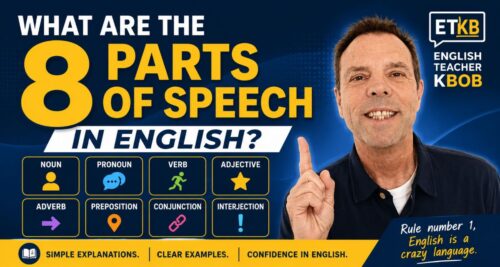
Every English word has a job in a sentence. The eight parts of speech help us understand what those jobs are and how words work together.
The eight parts of speech are nouns, pronouns, verbs, adjectives, adverbs, prepositions, conjunctions, and interjections.
You don’t need to memorize everything at once. Start by learning what each part of speech does and how to recognize it in a simple sentence. That foundation will make it easier to understand grammar and build better English sentences.
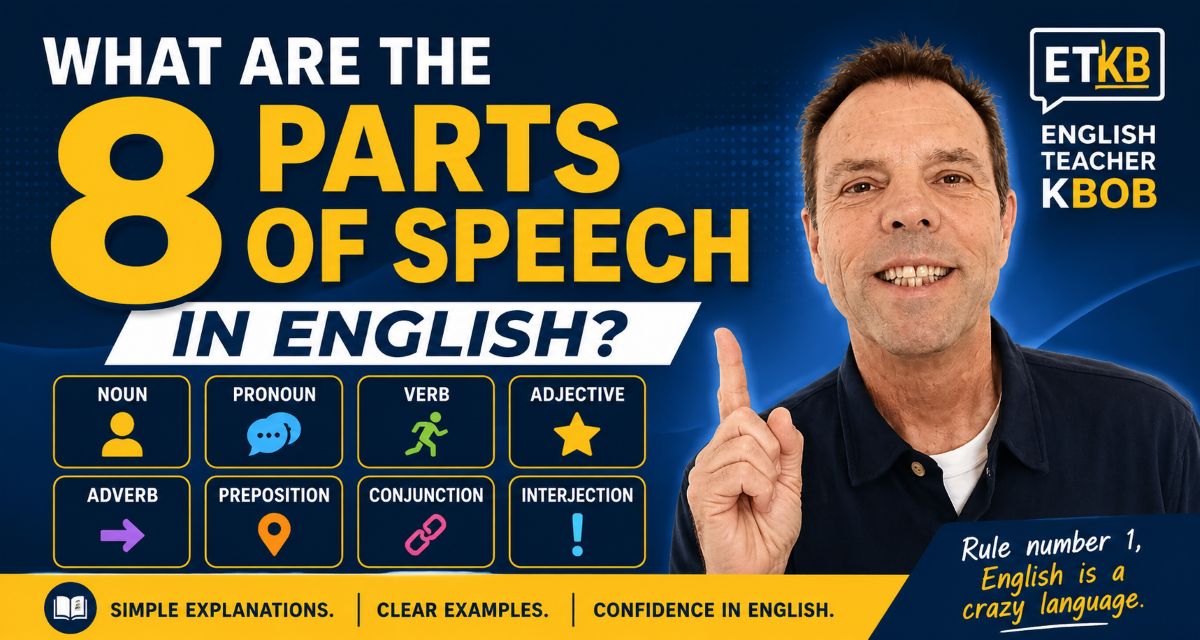
Exploring the Eight Essential Parts of Speech
Each part of speech has a different job in a sentence. Some words name people, places, things, or ideas. Others show actions, describe words, connect ideas, or show relationships between words.
Here’s a quick look at all eight before we explore them individually.
| Part of Speech | Description |
|---|---|
| Noun | Names a person, place, thing, or idea (e.g., teacher, city, book, freedom). |
| Pronoun | Replaces a noun to avoid repetition (e.g., he, she, it, they). |
| Verb | Expresses an action or state of being (e.g., run, is, write, become). |
| Adverb | Modifies a verb, adjective, or another adverb, often indicating how, when, where, or to what extent (e.g., quickly, very, well). |
| Preposition | Shows the relationship between a noun (or pronoun) and other words in a sentence (e.g., in, on, by, with). |
| Conjunction | Connects words, phrases, or clauses (e.g., and, but, because, although). |
| Interjection | Expresses emotion or a sudden feeling, usually standing alone (e.g., Wow!, Ouch!, Oh!). |
| Adjective | Modifies or describes a noun or pronoun (e.g., blue, tall, happy). Articles (a, an, the) are special kinds of adjectives. |
Understanding the parts of speech helps you see how English sentences are built. Instead of looking at a sentence as a group of unrelated words, you can begin to recognize the job each word is doing.
Start with the most important building blocks. Nouns name people, places, things, and ideas. Verbs show actions or states. Pronouns can replace nouns so we don’t have to repeat the same words again and again.
As you become more comfortable with those basics, adjectives and adverbs add information, prepositions show relationships, conjunctions connect words and ideas, and interjections express emotion.
You don’t need to master all eight at once. Learn to recognize them, practice them in sentences, and build your understanding step by step.
In-Depth Breakdown of Each Part of Speech
Nouns
Nouns name people, places, things, and ideas.
Examples:
- person: teacher, Maria
- place: school, London
- thing: phone, book
- idea: happiness, freedom
Nouns can be common nouns, such as city or teacher, or proper nouns, such as London or Maria.
Example: Maria reads a book at school.
In this sentence, Maria, book, and school are nouns.
Pronouns
Pronouns are words that replace nouns. They help us avoid repeating the same nouns again and again.
Examples:
subject pronouns: I, you, he, she, it, we, they
object pronouns: me, you, him, her, it, us, them
possessive pronouns: mine, yours, his, hers, ours, theirs
reflexive pronouns: myself, yourself, himself, herself
Example: Maria has a new phone. She uses it every day.
She replaces Maria, and it replaces phone.
This also brings the section into alignment with the pronoun distinctions we’re teaching elsewhere in ETKB.
Verbs
Verbs tell us about actions or states of being. Every complete English sentence needs a verb.
Examples:
- action verbs: run, work, eat, study
- state/linking verbs: be, seem, become
- helping verbs: be, have, do, will, can
Example: Carlos works every day.
Works is the verb because it tells us what Carlos does.
Example: Carlos is tired.
Is is the verb. It describes Carlos’s state rather than an action.
Adjectives describe nouns and pronouns. They give us more information about a person, place, thing, or idea.
Adjectives
Adjectives can describe things such as:
- size: big, small
- color: blue, green
- appearance: beautiful, tall
- quality: good, difficult
Example: They live in a big, blue house.
Big and blue are adjectives because they describe the noun house.
Adjectives usually come before a noun or after a linking verb.
Example: The house is big.
Adverbs
Adverbs give us more information about verbs, adjectives, and other adverbs.
Adverbs can tell us:
- how: slowly, carefully
- when: today, soon
- where: here, outside
- how often: always, sometimes
- to what degree: very, extremely
Example: Maria speaks slowly.
Slowly is an adverb because it tells us how Maria speaks.
Example: The test is very difficult.
Very is an adverb because it modifies the adjective difficult.
Many adverbs end in -ly, but not all of them do.
Prepositions
Prepositions show the relationship between words in a sentence. They often tell us about place, time, direction, or movement.
Examples:
- place: in, on, under, next to
- time: at, on, before, after
- direction or movement: to, from, into, through
Example: The book is on the table.
On is a preposition. It shows the relationship between book and table.
Example: We have class at 9:00.
At is a preposition that tells us about time.
Conjunctions
Conjunctions connect words, phrases, and clauses. They help us join ideas together.
Common conjunctions include:
- and — adds information
- but — shows a contrast
- or — shows a choice
- because — gives a reason
- so — shows a result
Example: Maria works and goes to school.
And connects two actions.
Example: I stayed home because I was sick.
Because connects the reason to the main idea.
Interjections
Interjections are words or short phrases that express emotion or a sudden reaction.
Common interjections include:
- Wow! — surprise or admiration
- Oh! — surprise or realization
- Ouch! — pain
- Hey! — getting someone’s attention
Example: Wow! That’s a beautiful house.
Wow is an interjection because it expresses a strong reaction.
Interjections often stand apart from the rest of the sentence and are commonly followed by an exclamation point.
Common Missteps and Mastery Tips
One important thing to remember is that a word’s part of speech can sometimes change depending on how it is used in a sentence.
For example:
That is a fast car.
Fast is an adjective because it describes the noun car.
The car moves fast.
Fast is an adverb because it tells us how the car moves.
Don’t try to identify a part of speech by looking at the word alone. Look at the job the word is doing in the sentence.
How Can You Practice the Parts of Speech?
Start with short, simple sentences. Find the noun or pronoun and the verb first. Then look for words that describe, connect, or add information.
Try these strategies:
- Identify the parts of speech in sentences you read.
- Write a simple sentence and label each word’s job.
- Replace a noun with a pronoun and see how the sentence changes.
- Add an adjective or adverb to give the sentence more information.
- Practice a few sentences at a time instead of trying to memorize all eight parts of speech at once.
The goal isn’t simply to memorize eight definitions. The goal is to recognize how words work together to build English sentences.
Practice the 8 Parts of Speech
Ready to practice? Use this crossword to review the eight parts of speech and test what you’ve learned.
What Should You Learn Next?
Understanding the eight parts of speech gives you a foundation for understanding how English sentences work.
If you’re still building your sentence skills, continue with Foundation 0B: Sentence Foundations. You’ll practice subjects, nouns, pronouns, the verbs be, have, and do, and learn how to build statements, questions, and negative sentences.
As you continue learning, come back to the eight parts of speech whenever you need help understanding what job a word is doing in a sentence.
Build confidence. Communicate clearly. Succeed every day.
This is a fantastic overview of the parts of speech! Understanding these foundational elements truly is like building a toolbox for effective communication. I appreciate the accessible explanations and practical examples—it makes each part of speech feel approachable and applicable, even for everyday use.
I found the tips on balancing adjectives and adverbs especially valuable. It’s easy to get carried away with descriptions, but striking that balance really does enhance clarity and impact. I also loved the idea of practicing with simple exercises to reinforce these concepts.
For anyone looking to improve their writing, mastering these basics is a game changer. Thanks for breaking it down in such an engaging way!
Thanks for your comments JealousLi.