
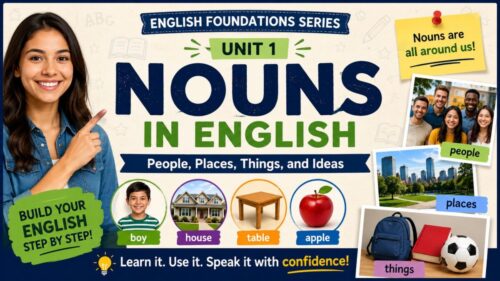
Learn nouns in English with simple explanations, visuals, speaking practice, and a free worksheet for adult ESL students.
Guess what? When you click and buy through our links, you’re doing more than improving your game. You’re supporting us in a way that doesn’t cost you extra but helps us keep bringing you the best drills and tips. It’s a slam dunk for both of us!
Nouns are one of the most important building blocks in English. If you understand nouns, you can begin to describe people, places, and things around you.
In this lesson, you will learn:
- What a noun is
- Person nouns
- Place nouns
- Thing nouns
- How to use nouns in real-life sentences
This lesson is designed especially for adult ESL students.
Summary
- A noun names a person, place, or thing.
- Nouns are found in almost every sentence.
- Learning nouns helps you speak and write more confidently.
Table of Contents
- What is a noun?
- Why are nouns important?
- Person, place, and thing nouns
- Real-life examples
- Common mistakes
- Free worksheet
- Final thoughts
What Is a Noun?
A noun is a word that names a: Person, Place, or Thing.
Examples
| Category | Examples |
|---|---|
| Person | teacher, student, doctor, mother |
| Place | school, city, park, hospital |
| Thing | book, phone, table, car |
Why Are Nouns Important?
Nouns help us talk about the world around us.
Examples:
- My teacher is friendly.
- The school is big.
- My phone is new.
Without nouns, communication is almost impossible.
Dynamic Infographic: Person, Place, and Thing Nouns
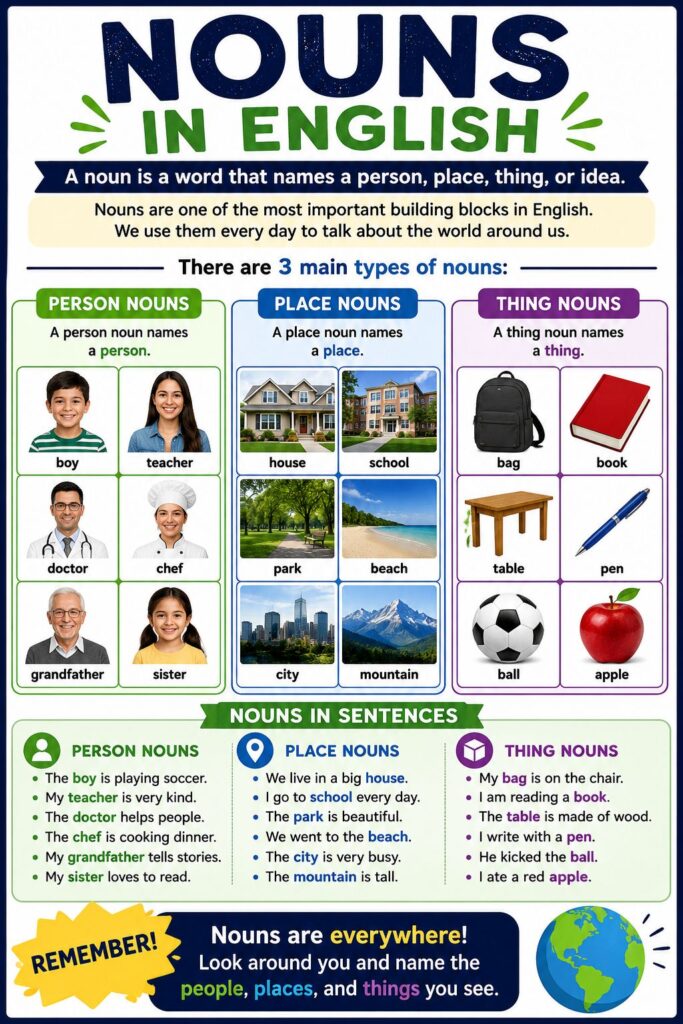
Remember
A noun names a person, place, or thing.
Real-Life Examples
Family
- My mother is kind.
- My father is tired.
School
- The teacher is helpful.
- The classroom is clean.
Everyday Things
- My phone is old.
- The book is on the table.
Common Mistakes
| Incorrect | Correct |
| Teacher is nice. | The teacher is nice. |
| My school big. | My school is big. |
To improve faster, regular speaking practice is essential.
If you want extra support, consider practicing with:
- https://www.italki.com/affshare?ref=af26596988
- https://www.englishclass101.com/member/go.php?r=4904301&l=%2F
- https://www.kqzyfj.com/click-100992175-14103335
Speaking Practice
Say whether each noun is a person, place, or thing.
- teacher
- school
- phone
- doctor
- city
- computer
Then make a sentence with each word.
Download The Free Worksheet
Get the Complete Lesson
Get the full lesson with:
- Student worksheets (printable + fillable PDF)
- Teacher answer key
- Picture dictionary
- Speaking activities
- Writing practice
- Dictation
Visit The KBob Teacher Toolbox:
Final Thoughts
Nouns are the foundation of English. When you understand nouns clearly, it becomes much easier to learn pronouns, verbs, and sentence structure.
Start by mastering person, place, and thing nouns.
What Do You Think?
Can you write one person noun, one place noun, and one thing noun?
What do you think about this lesson? Is it helpful? Do you understand nouns?
Leave comments and questions in the space below. I’d love to hear from you.
I always reply.
Write one sentence in the comments now.
ESL, #LearnEnglish, #EnglishGrammar, #AdultESL, #EnglishVocabulary
Hi Bob,
I enjoyed reading this article because grammar explanations can easily become dry or overly technical, but this felt much more approachable. Nouns sound simple at first, yet they seem to cause a surprising amount of confusion for adult ESL learners, especially when people start dealing with abstract nouns or words that can function differently depending on the sentence.
One thing I noticed is that many learners understand grammar rules when reading them, but freeze when trying to use them naturally in real conversation. In my opinion, examples connected to everyday situations help much more than memorizing definitions alone, so I liked the practical style of your explanations.
I was curious about one thing while reading this: in your experience, what type of nouns tend to confuse adult ESL students the most? Proper nouns, collective nouns, abstract nouns, or something else entirely? Also, do you think speaking practice is more effective than written exercises when trying to make grammar feel natural?
Cheers,
Boris
Hi Boris, thanks for your comments.
To address your questions, an English class consists of four basic elements: reading, writing, listening, and speaking. They are supported by grammar and pronunciation. All aspects are important.
Everyone is different and struggles with different things, as well as learn differently. I can’t really answer what kind(s) of nouns people struggle with most. On the other hand, you’re right about how they get confused about the different kinds of nouns, especially when words that are nouns can be used as other parts of speech (adjectives, verbs etc.). They all struggle with that.
As for what practice is more/most effective, the bottom line is, anything anyone tries to learn, whether it be a language or anything else, continuous and constant practice is vital. The reality is, in a practical sense, for most people, speaking is probably what they need to focus on most when interacting with other people. So, that’s probably where they need the most practice but, as I said, everyone is different.
KBob
Love these simple and direct accesislbe for new learners of any language. Great breakdown and quick answers that make it seem so easy to learn along with. Love the image breakdown of each type of nouns to look out for. Very easy to share this information with people I know who ould use it.
Hi John, thanks for your comments.
KBob mike