
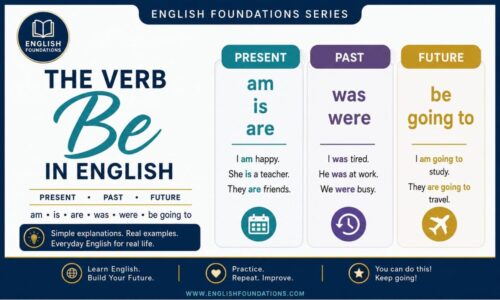
Learn am, is, are, was, were, and future forms of the verb be with examples, visuals, and a free ESL worksheet.
Guess what? When you click and buy through our links, you’re doing more than improving your game. You’re supporting us in a way that doesn’t cost you extra but helps us keep bringing you the best drills and tips. It’s a slam dunk for both of us!
The verb “be” is one of the most important verbs in English.
Students use it every day to talk about:
- who they are
- how they feel
- where they are
- what they were doing in the past
- what is going to happen in the future
In this lesson, you will learn:
- am, is, are
- was, were
- be going to
- past, present, and future
This lesson is designed for adult ESL students and beginner English learners.
New to English? Start Here
If you’re a beginner, start with English Teacher KBob’s free Foundation 0 lessons. You’ll learn the basics step by step, including how to build sentences and use important verbs like be, have, and do.
Summary
- The verb “be” is essential in English.
- Present tense uses am, is, and are.
- Past tense uses was and were.
- Future forms often use going to be.
- Mastering this verb builds speaking confidence.
Table of Contents
- What is the verb be?
- am, is, and are
- was and were
- Future forms with going to be
- Past, present, and future
- Common mistakes
- Speaking practice
- Free worksheet
- Final thoughts
What Is the Verb “Be”?
The verb “be” helps us describe: people, places, things, feelings, conditions
Examples:
- I am tired.
- She is a teacher.
- They are busy.
am, is, and are
| Subject | Verb Be | Example |
|---|---|---|
| I | am | I am ready. |
| You | are | You are my friend. |
| He | is | He is tired. |
| She | is | She is happy. |
| It | is | It is a school. |
| We | are | We are classmates. |
| They | are | They are students. |
If you want additional guided practice, consider:
- https://www.englishclass101.com/member/go.php?r=4904301&l=%2F
- https://www.kqzyfj.com/click-100992175-14103335
was and were
Use was and were to talk about the past.
| Subject | Past Form | Example |
| I | was | I was tired yesterday. |
| He | was | He was at work. |
| She | was | She was happy. |
| It | was | It was closed. |
| You | were | You were late. |
| We | were | We were busy. |
| They | were | They were at school. |
Future Forms With Going to Be
Use going to be to talk about the future.
| Subject | Future Form | Example |
| I | am going to be | I am going to be busy tomorrow. |
| He | is going to be | He is going to be late. |
| We | are going to be | We are going to be ready. |
| They | are going to be | They are going to be here tomorrow. |
Dynamic Infographic: Past, Present, and Future
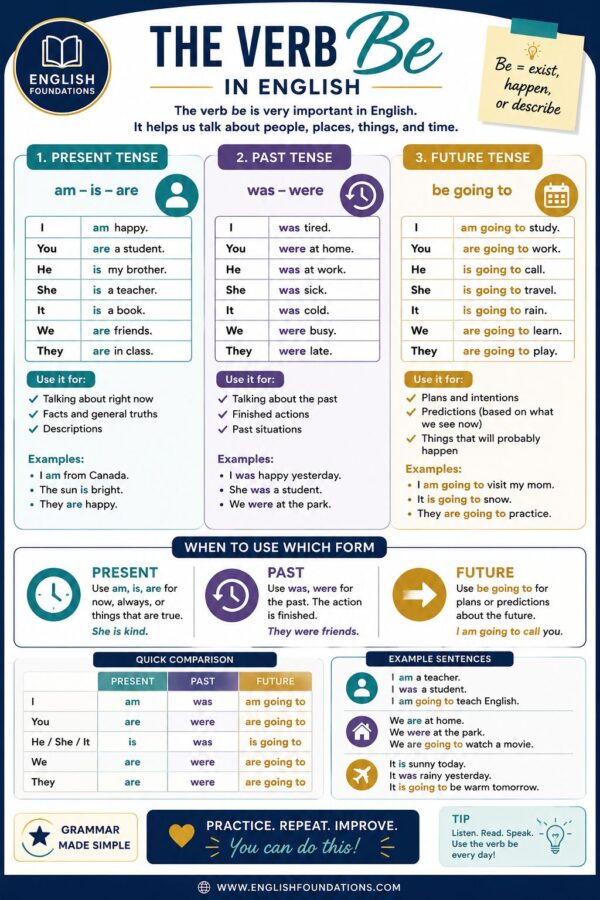
| Time | Example |
| Yesterday | I was tired. |
| Today | I am tired. |
| Tomorrow | I am going to be tired. |
Remember
- Past = was / were
- Present = am / is / are
- Future = going to be or will be
Common Mistakes
| Incorrect | Correct |
| I is tired. | I am tired. |
| They was busy. | They were busy. |
| He are late. | He is late. |
Regular speaking practice is one of the best ways to build accuracy.
For one-on-one conversation practice, you may find this helpful:
Speaking Practice
Answer these questions aloud.
- Are you tired today?
- Were you busy yesterday?
- Are you going to be busy tomorrow?
- Is your teacher friendly?
- Were your classmates at school yesterday?
Free Worksheet
Get the Complete Lesson
Want the full lesson with:
- printable and fillable PDFs
- teacher answer key
- picture dictionary
- infographic
- speaking activities
- writing practice
- dictation
Visit The KBob Teacher Tool box:
Ready to Keep Building Your English?
The verb be is one of the foundations of English. Continue with English Teacher KBob’s free Foundation 0 lessons to practice complete sentences and important verbs step by step.
Final Thoughts
The verb “be” is one of the most important foundations in English.
When students master:
- am, is, are
- was, were
- going to be
They gain confidence in speaking about the present, the past, and the future.
The verb “be” in some form is used in almost every sentence in the English language.
What Do You Think?
Which form is most difficult for you or your students: am, is, are, was, or were?
Does this lesson help you understand the verb “be”?
Leave comments and questions in the space below. I’d love to hear your thoughts.
Leave one or more sentences in the comments using the verb “be”.
I always reply.
#ESL, #LearnEnglish, #EnglishGrammar, #AdultESL, #EnglishSpeaking
Thank you for sharing this very helpful article about the verb “be” in English and its different forms such as am, is, are, was, were, and future forms. I think this is one of the most important grammar topics for English learners because the verb “be” is used so often in everyday speaking and writing, yet it can still be confusing for beginners due to its many forms and uses.
I do have a few questions after reading the article. What do you think is the most effective way for beginners to practice using the correct form of the verb “be” naturally in conversation? Also, do most learners struggle more with the present forms like “am,” “is,” and “are,” or with switching correctly between past and future forms such as “was,” “were,” and “will be”?
I also found the discussion about different tenses very useful because many learners understand grammar rules while studying, but still become uncertain when speaking quickly in real conversations. From my experience learning and practicing English, repeated daily exposure through reading, listening, and speaking helps make these forms feel more natural over time. I’ve noticed that practicing simple sentences regularly improves confidence and reduces mistakes gradually.
In my opinion, grammar lessons about the verb “be” are extremely important because this verb forms the foundation for many English sentence structures and tenses. A strong understanding of these forms can help learners improve both accuracy and confidence in communication. Thank you again for sharing this clear and beginner-friendly explanation of such an essential English grammar topic.
Hi Iyere, welcome back. Thanks for your comments. I don’t actually know what THE best way is to learn or teach the verb is but I know how I teach it and it seems to be very effective. I drill my students often on the verbs Be, Do, and Have because they are so common. I have them read sentences. Then I have them change the sentence to a question, and a negative statement. I have them do that for the present, the past and the future tenses. Practice makes better.
KBob
I like this lesson, reading and speaking correctly is so important and it’s so important to have a place where you can really learn to manage the English language well. This is a needed website keep up the good work. It is a joy to read well and write well this site will help a lot of people.
Jan
Hi Jan, thanks for your comments. I’m glad you like the lesson and the site. Your comments are always welcome.
KBob
Thanks for your comments, Jan. Visit and comment anytime.
KBob
I like this website because the English language is very expressive and it’s important to learn to speak English well. I left a comment on the site itself on this article the verb Be in English. I am leaving one here too. Keep writing about the different verbs and more. English or language in general is important to learn correctly. Keep posting these valuable posts.
Thanks Janine.
KBob