

Learn do, does, did, don’t, doesn’t, and didn’t with examples, visuals, and a free worksheet.

Guess what? When you click and buy through our links, you’re doing more than improving your game. You’re supporting us in a way that doesn’t cost you extra but helps us keep bringing you the best drills and tips. It’s a slam dunk for both of us!
Summary
Students learn how to:
- ask yes/no questions
- make negative sentences
- use short answers
- talk about the present and the past
This lesson is designed for adult ESL students and beginner English learners.
New to English? Start Here
If you are a beginner, build your English step by step with my free Foundation English lessons for adult learners.
Table of Contents
- What is the verb do in English?
- How do do and does describe actions?
- How do do and does add emphasis?
- How do do and does form questions?
- How do don’t and doesn’t make negative sentences?
- How do did and didn’t work in the past?
- Common mistakes
- Free worksheet
- Get the complete lesson
What Is the Verb “Do” in English?
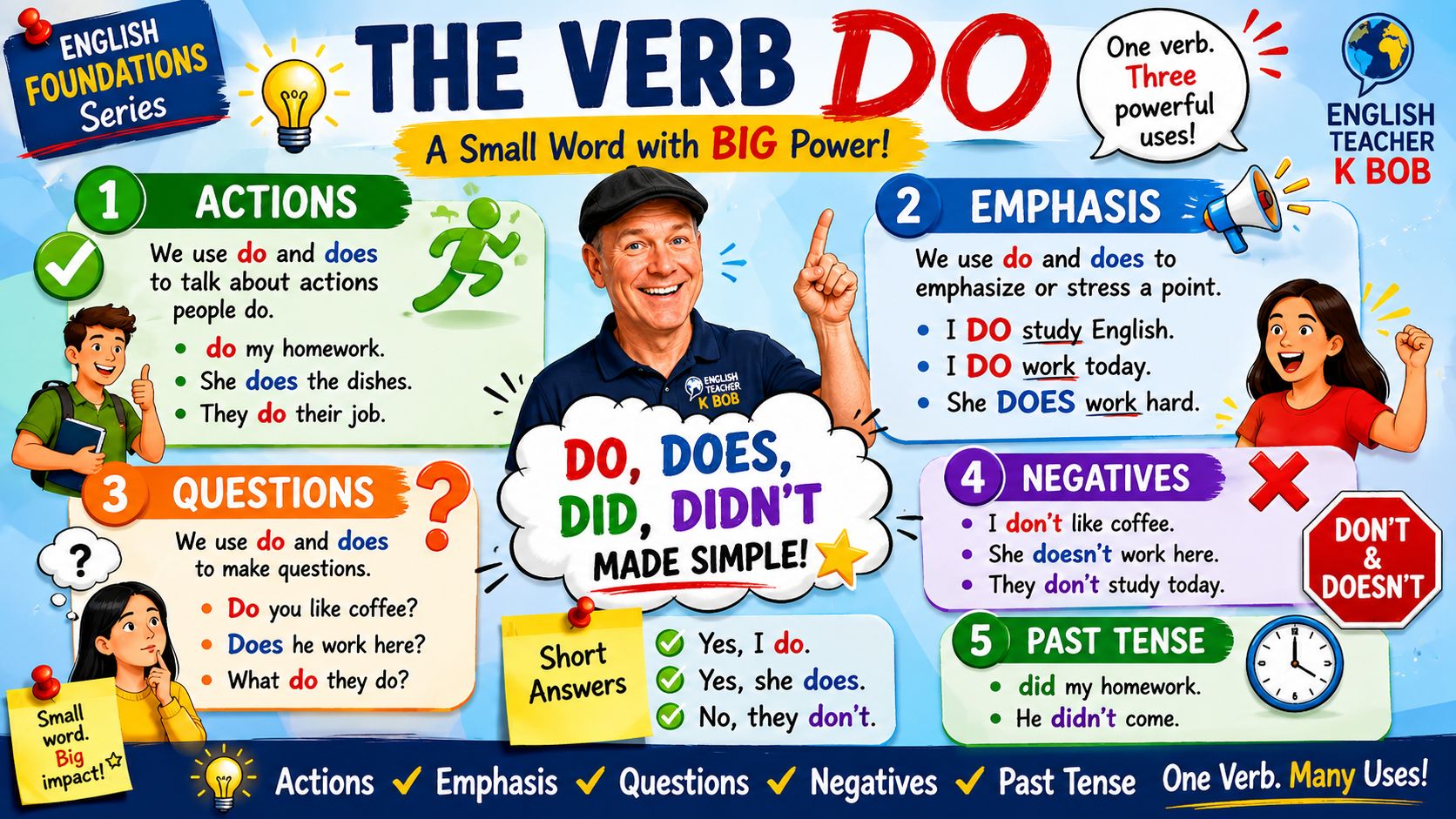
The verb “do” has several important jobs in English.
First, it can describe actions.
- I do my homework.
- I do the dishes.
- She does her job.
Second, it can emphasize a statement.
- I do study English every day.
- She does work very hard.
Third, it helps us ask questions.
- Do you like coffee?
- Does he work here?
Fourth, it helps us make negative sentences.
- I don’t drink coffee.
- He doesn’t work on Sundays.
Finally, it helps us talk about the past.
- Did you work yesterday?
- I didn’t work yesterday.
The verb “do” is one of the most important verbs in English.
How Do Do and Does Describe Actions?
When do and does are main verbs, they describe actions that people perform.
| Subject | Example |
|---|---|
| I | I do my homework. |
| You | You do the laundry. |
| He | He does his job. |
| She | She does the dishes. |
| We | We do our exercises. |
| They | They do their work. |
How Do Do and Does Add Emphasis?
Sometimes we use do and does to emphasize that something is true.
| Sentence | Meaning |
| I do study English. | I really study English. |
| She does work hard. | She really works hard. |
| We do need more practice. | We really need more practice. |
This use is especially helpful when correcting misunderstandings.
How Do Do and Does Form Questions?
Use do and does to ask yes/no questions in the present tense.
| Question | Short Answer |
| Do you like coffee? | Yes, I do. |
| Do they work here? | No, they don’t. |
| Does he speak English? | Yes, he does. |
| Does she live nearby? | No, she doesn’t. |
Rule
- I, you, we, they → do
- he, she, it → does
How Do Don’t and Doesn’t Make Negative Sentences?
Use don’t and doesn’t to make negative statements in the present tense.
| Affirmative | Negative |
| I drink coffee. | I don’t drink coffee. |
| He works here. | He doesn’t work here. |
| They study English. | They don’t study English. |
If you want extra listening and grammar practice, check out:
- https://www.englishclass101.com/member/go.php?r=4904301&l=%2F
- https://www.kqzyfj.com/click-100992175-14103335
How Do Did and Didn’t Work in the Past?
Use did to ask questions and didn’t to make negative sentences in the past.
| Question | Negative |
| Did you work yesterday? | I didn’t work yesterday. |
| Did she call you? | She didn’t call me. |
| Did they study? | They didn’t study. |
Important Rule
After did and didn’t, use the base form of the verb.
Correct:
- Did you work yesterday?
- I didn’t work yesterday.
Incorrect:
- Did you worked yesterday?
- I didn’t worked yesterday.
Common Mistakes
| Incorrect | Correct |
| He don’t like coffee. | He doesn’t like coffee. |
| Did you worked yesterday? | Did you work yesterday? |
| She doesn’t likes pizza. | She doesn’t like pizza. |
| I didn’t worked. | I didn’t work. |
Speaking Practice
Answer these questions aloud.
- Do you do your homework every day?
- Does your teacher give homework?
- Do you study English at home?
- Did you work yesterday?
- Did you study English last night?
Download The Free Worksheet
Get the Complete Lesson
Want the full lesson with:
- printable and fillable PDFs
- teacher answer key
- picture dictionary
- infographic
- speaking activities
- writing practice
- dictation
Visit The KBob Teacher Toolbox:
Final Thoughts
The verb “do” is one of the most useful verbs in English.
When students master:
- do and does
- don’t and doesn’t
- did and didn’t
- actions and emphasis
They can ask better questions, make accurate negative statements, and speak with greater confidence.
Ready to Keep Building Your English?
Now that you’ve practiced do, does, did, don’t, doesn’t, and didn’t, keep building your English step by step with English Teacher KBob’s Foundation English lessons for adult beginners.
What Do You Think?
Which use of the verb do is most difficult for you or your students: actions, emphasis, questions, or negative statements?
Was/Is this lesson helpful? Do you now know how to use the verb DO?
Let me know in the comments what you think about this lesson or if you have questions. I’d love to hear from you.
I always reply.
Call to Action
Link to The KBob Teacher Toolbox.
ESL, #LearnEnglish, #EnglishGrammar, #AdultESL, #BeginnerEnglish
Hi KBob,
I think the hardest part for a lot of English learners is knowing when to use “do” and when not to use it in questions. Things like “You like coffee?” vs “Do you like coffee?” can get confusing fast, especially when people hear casual spoken English. The examples and charts here make it much easier to see the pattern.
I’ve also noticed many learners keep adding “-ed” after “did,” so the section about “Did you work?” instead of “Did you worked?” was useful. Do your students usually struggle more with present tense forms like “doesn’t,” or with past tense forms like “didn’t”? And do you think conversation practice helps students learn these faster than grammar drills alone?
Reagrds,
Boris Roman
Hi Boris, thanks for your comments. Absolutely conversation practice helps more than anything. The drills are the beginning, the springboard to the real learning, which is using the language in real life. They all struggle with different things. I try to practice everything with all of them so that they all get what they need. At least, I like to think they do.
KBob
This was a really helpful explanation of how “do” works in English. I remember when I was learning English, it was difficult for me to know when to use do, does, and did correctly, especially in conversations.
I visit other blogs too because I’m still an English learner, and posts like yours give me more practice while also helping me understand grammar in a simple way. The examples in this article were easy to follow and didn’t feel confusing or too technical.
I also liked the section about don’t and didn’t since those are mistakes a lot of learners make in everyday speaking. Do you think listening practice helps learners master these verb forms faster than written exercises?
Hi Monica, thanks for your comments. I think all practice helps. Listening is as important as anything else. Practice is where the real learning happens.
KBob