
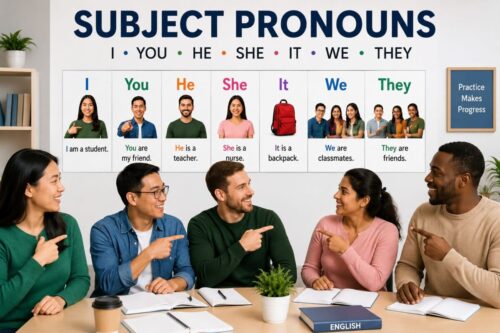
Learn subject pronouns in English with simple explanations, visuals, speaking practice, and a free ESL worksheet for adult learners.
Guess what? When you click and buy through our links, you’re doing more than improving your game. You’re supporting us in a way that doesn’t cost you extra but helps us keep bringing you the best drills and tips. It’s a slam dunk for both of us!
Subject pronouns are one of the most important foundations in English. If students do not understand pronouns clearly, they often struggle with speaking, listening, sentence structure, and confidence.
The good news is that subject pronouns are simple once students understand how they replace nouns in real conversation.
This lesson will help you learn:
- I
- You
- He
- She
- It
- We
- They
You will also practice pronunciation, speaking, and sentence building using real-life examples.
Summary
- Subject pronouns replace nouns
- Pronouns help English sound more natural
- Pronouns are essential for speaking and conversation
- Real-life practice improves confidence quickly
Table of Contents
- What are subject pronouns?
- Why are subject pronouns important?
- Subject pronouns chart
- Real-life examples
- Common mistakes
- Speaking practice
- Free worksheet
- Final thoughts
What are subject pronouns?
Subject pronouns replace nouns in a sentence.
Instead of repeating names again and again, we use pronouns.
Example:
John is tired.
He is tired.
Maria is my teacher.
She is my teacher.
Subject pronouns make English shorter, smoother, and more natural.
Why are subject pronouns important?
Subject pronouns are part of almost every English sentence.
Students use them constantly when speaking:
| Noun Sentence | Pronoun Sentence |
|---|---|
| Maria is tired. | She is tired. |
| John is busy. | He is busy. |
| The students are happy. | They are happy. |
| Ana and I are classmates. | We are classmates. |
When students learn pronouns well, they become more confident speakers.
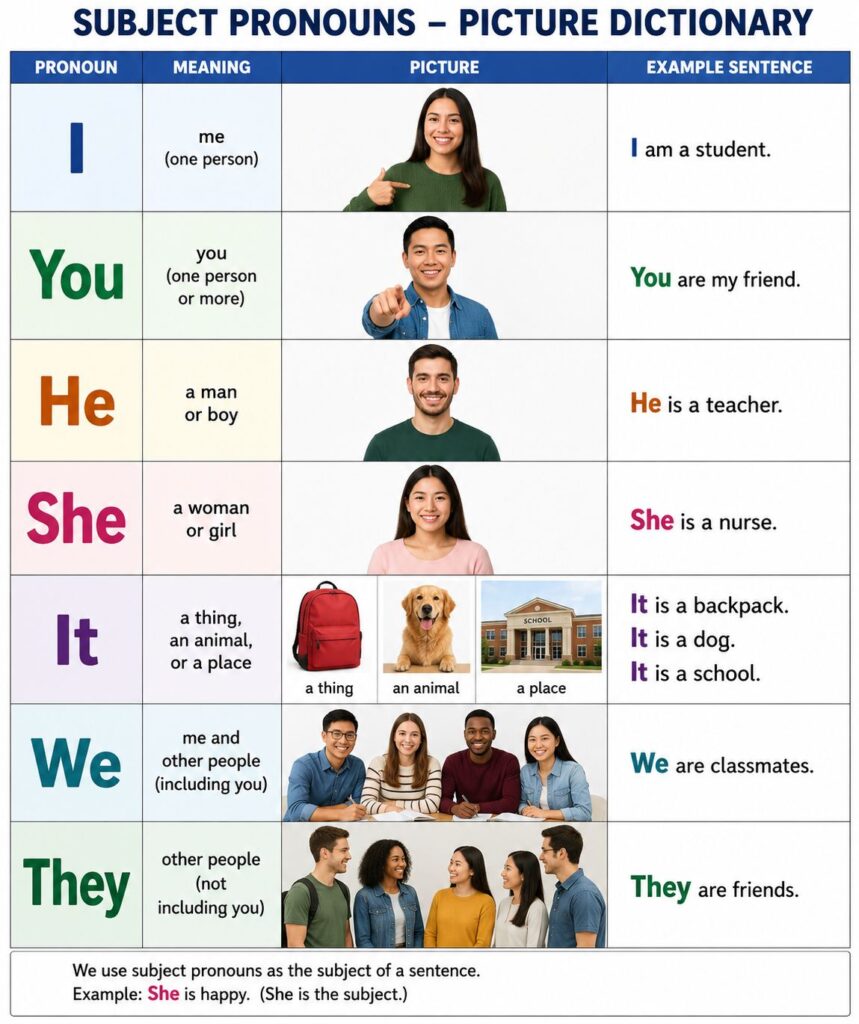
Subject Pronouns Picture Dictionary
SUBJECT PRONOUNS — PICTURE DICTIONARY
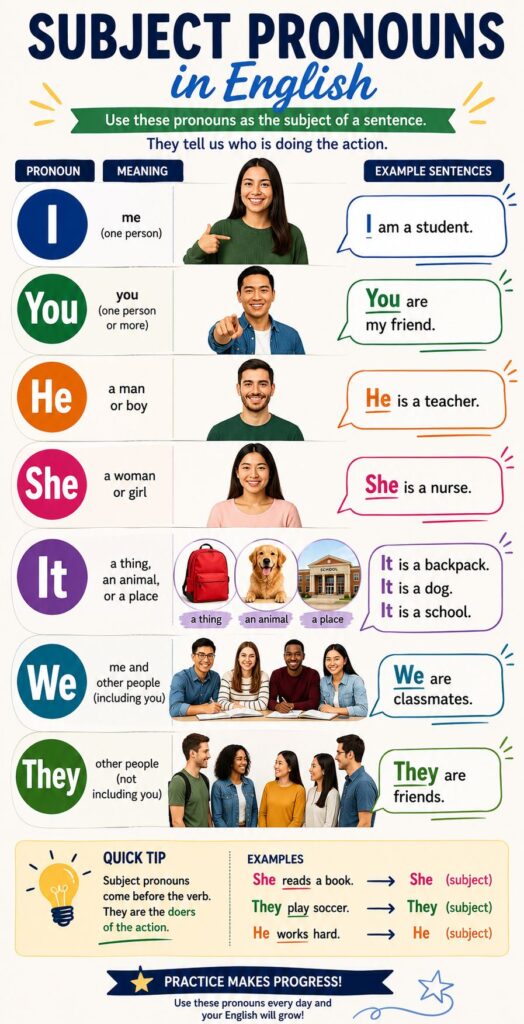
Dynamic Infographic
HOW SUBJECT PRONOUNS WORK
Replace the noun with a pronoun.
| Noun | Pronoun | New Sentence |
| Maria | She | She is happy. |
| David | He | He is tired. |
| My dog | It | It is hungry. |
| Ana and I | We | We are classmates. |
| The students | They | They are busy. |
QUICK PATTERN
| Pronoun | Example |
| I | I am a teacher. |
| You | You are my friend. |
| He | He is tired. |
| She | She is happy. |
| It | It is a phone. |
| We | We are classmates. |
| They | They are students. |
WHY THIS MATTERS
Without pronouns:
“Maria is tired. Maria is my friend. Maria is a teacher.”
With pronouns:
“Maria is tired. She is my friend. She is a teacher.”
Pronouns make English sound natural.
Real-Life Speaking Examples
Example 1 — Family
My brother is funny.
He is funny.
My parents are tired.
They are tired.
Example 2 — School
Maria and I are classmates.
We are classmates.
The teacher is busy.
She is busy.
Example 3 — Everyday Objects
My phone is new.
It is new.
The school is big.
It is big.
Common Mistakes With Subject Pronouns
| Incorrect | Correct |
| Maria is tired. Maria is busy. | Maria is tired. She is busy. |
| John and me are students. | John and I are students. |
| The students is happy. | The students are happy. |
Many students improve faster when they hear and repeat correct patterns often.
If you want extra pronunciation and speaking support, platforms like: italki and English Class 101
can help students practice with guided lessons and real conversations.
Speaking Practice
Practice these sentences aloud.
- I am ready.
- You are my friend.
- He is tired.
- She is a teacher.
- It is a dog.
- We are classmates.
- They are busy.
Pronunciation and repetition are very important for confidence.
Students who practice speaking regularly usually improve much faster.
Another helpful option for conversation practice is: Rocket Languages
Free Worksheet
Replace the noun with a pronoun.
Full ESL Lesson
Want the complete lesson with:
- speaking practice
- worksheets
- role-plays
- dictation
- answer keys
- printable + fillable PDFs
Visit: KBob Teacher Toolbox
Final Thoughts
Subject pronouns are small words, but they are one of the most important building blocks in English.
Students who master pronouns become:
- more confident speakers
- better listeners
- stronger writers
- more natural communicators
Foundations matter.
What do you think?
Which pronoun is most difficult for your students or for you personally?
Was this lesson helpful?
Leave a comment or question below. I’d love to hear from you.
I always reply.
#ESL, #LearnEnglish, #EnglishGrammar, #AdultESL, #EnglishSpeaking, #ESLTeaching
I am sure it is a real challenge to teach English online, you must be a natural for teaching to provide such easy lessons on learning the English language.
NIce how you started with explaining what subject pronouns are, then took it one step at time to help your readers understand subject pronouns even better.
I always thought about learning another language from time to time, but I just never took the time to do it yet.
Jeff
Hi Jeff, thanks for your comments. It’s never too late. I have and have had students in their 80s trying to learn English. It’s definitely not as easy for the older folks but it’s still possible. They just need to practice more.
KBob
Thank you for sharing this helpful article about subject pronouns in English for adult ESL students. I found the topic very important because subject pronouns like I, you, he, she, it, we, and they are used in almost every sentence, and they form the foundation for correct English grammar.
I do have a few questions after reading the article. What are the most common mistakes adult learners make when using subject pronouns with the verb “to be”? Also, do you think learners improve faster by practicing speaking sentences aloud or by doing written grammar exercises first?
I also think subject pronouns can be confusing at the beginning because learners have to connect them correctly with verbs like am, is, and are, but with regular practice it becomes much more natural.
I think the article is very useful for ESL students because it explains a basic but essential grammar topic in a clear and practical way. Thank you again for sharing this helpful lesson.
Hi Iyere, thanks for your comments. You nailed the biggest problem that many students have. They mix up the pronouns.
KBob