
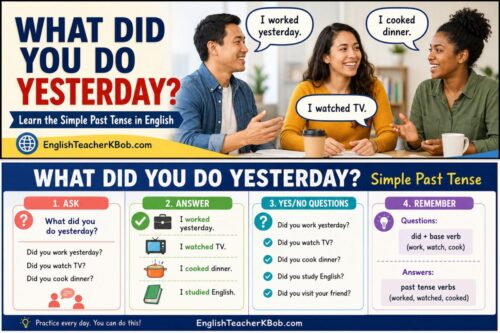
Learn how to talk about yesterday in English. Practice simple past tense questions and answers with examples, vocabulary, a video lesson, and a free practice pack.
This post may contain affiliate links. If you purchase through these links, I may earn a small commission at no additional cost to you. I only recommend resources that I believe can help English learners improve their skills.
Did someone ask you, “What did you do yesterday?” Did you know how to answer?
This is one of the most common questions in English. We use the simple past tense to talk about actions that happened before now and are finished.
In this lesson, you will learn how to ask and answer questions about yesterday, use common simple past verbs, and practice speaking, reading, writing, and listening.
Are You a Beginner? Start Here
If you are new to English or want to build a stronger foundation, start with Foundation 0: Personal English. Learn step by step and begin with Lessons 1–3 FREE
Table of Contents
- What Does “What Did You Do Yesterday?” Mean?
- How Do We Ask Questions About Yesterday?
- How Do We Answer Questions About Yesterday?
- What Are Some Common Simple Past Verbs?
- Can You Read and Practice a Conversation?
- Can You Answer These Questions?
- Can You Write About Yesterday?
- Watch the Video
- Download Your FREE Practice Pack
- Want More Practice?
What Does “What Did You Do Yesterday?” Mean?
“What did you do yesterday?” means:
What activities did you do on the day before today?
We use this question to ask about finished actions in the past.
Examples:
Today is Thursday.
Yesterday was Wednesday.
Today is June 25.
Yesterday was June 24.
People ask this question every day in English.
Friends ask it.
Family members ask it.
Coworkers ask it.
Teachers ask it.
It is an important question to learn.
Examples:
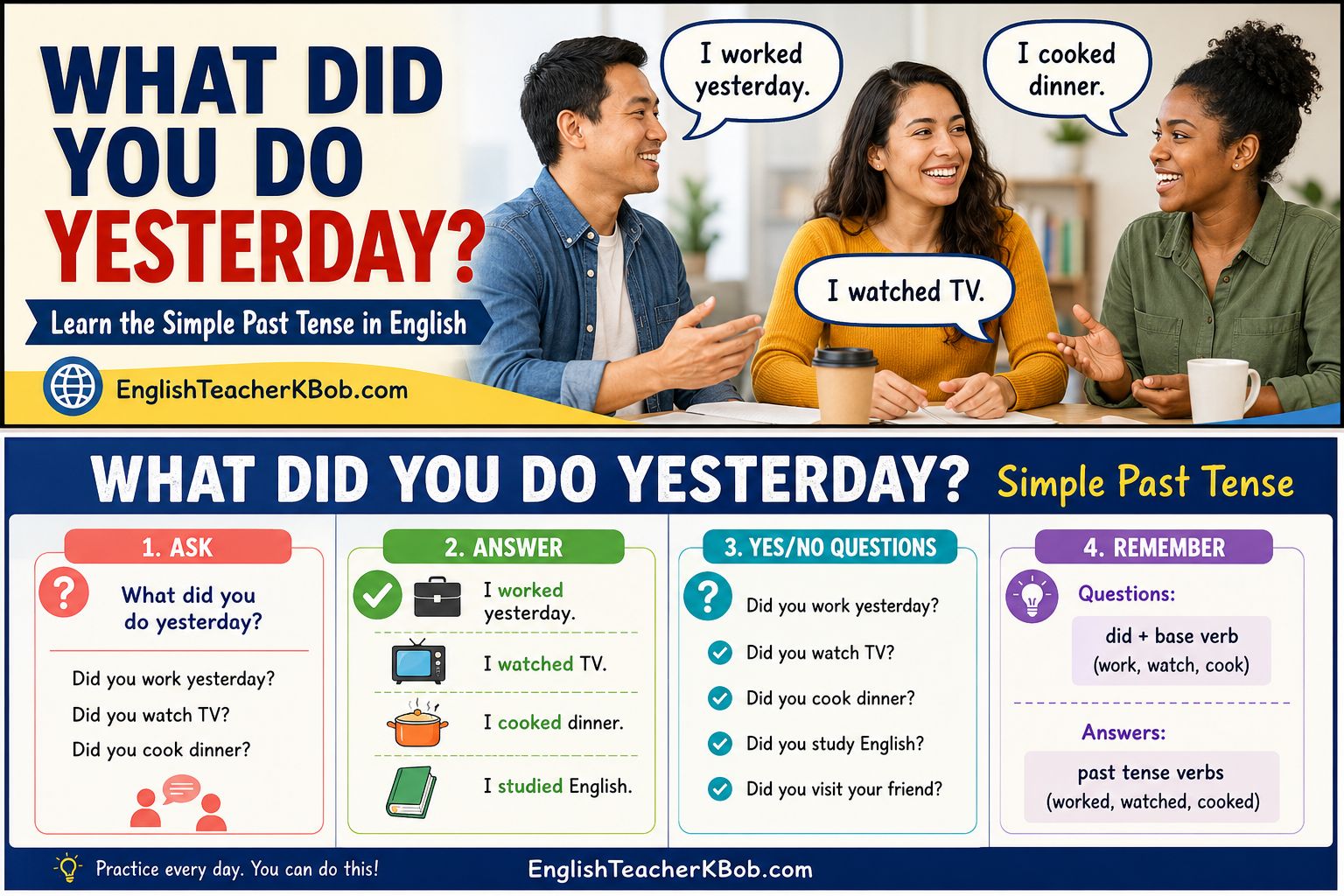
What did you do yesterday?
I worked yesterday.
What did you do yesterday?
I watched TV.
What did you do yesterday?
I cooked dinner.
What did you do yesterday?
I studied English.
How Do We Ask Questions About Yesterday?
We often use did to ask questions in the simple past tense.
Examples:
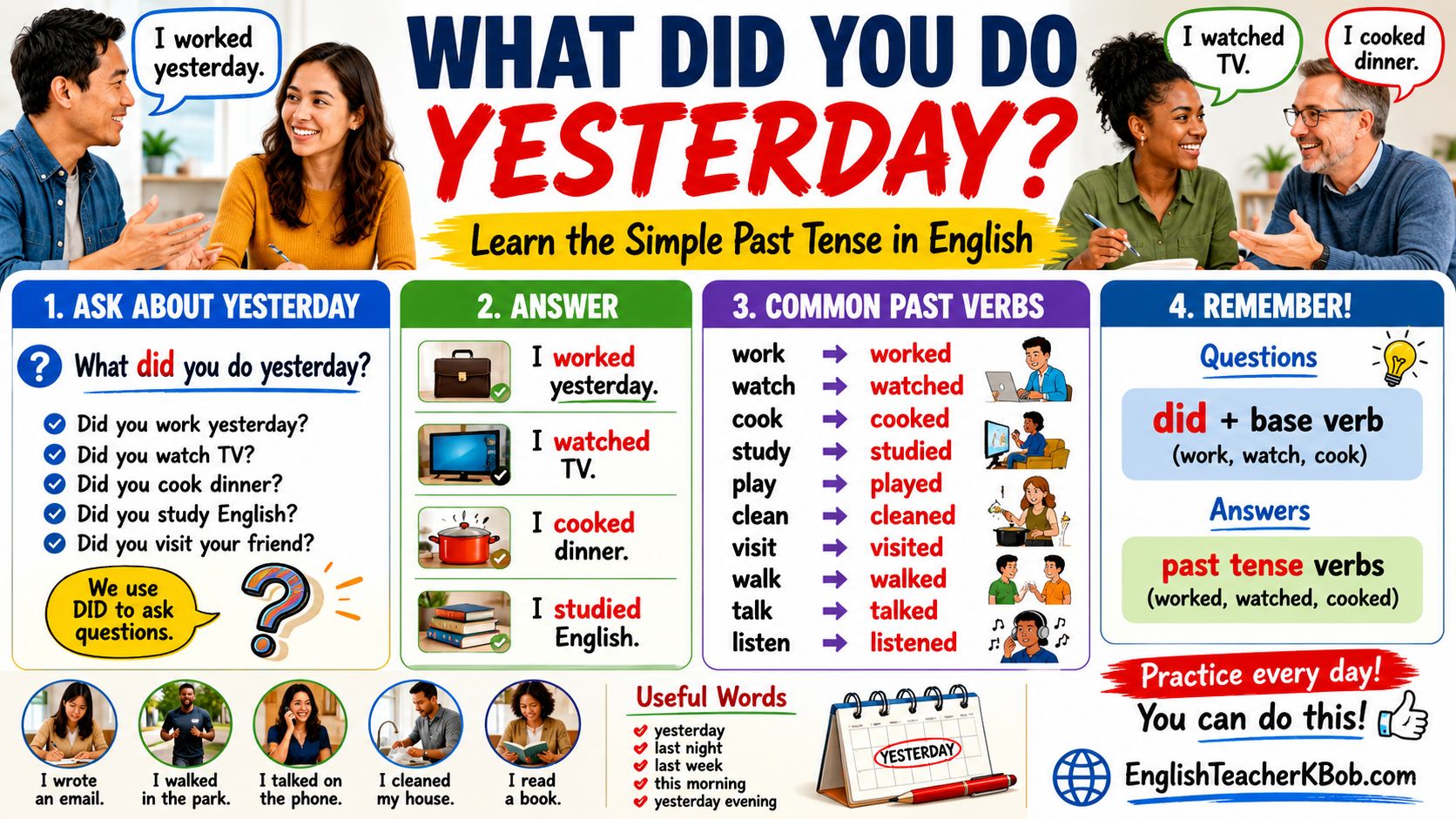
What did you do yesterday?
Did you work yesterday?
Did you watch TV last night?
Did you cook dinner yesterday?
Did you study English yesterday?
Notice something important.
We use did + the base form of the verb.
Correct:
Did you watch TV?
Did you work yesterday?
Did you cook dinner?
Incorrect:
Did you watched TV?
Did you worked yesterday?
Did you cooked dinner?
How Do We Answer Questions About Yesterday?
A simple answer to “What did you do yesterday?” uses the simple past tense. For example: “I worked yesterday.” You can also give a longer answer: “Yesterday, I worked, cooked dinner, watched TV, and talked to my family.
Question:
What did you do yesterday?
Answer:
I worked yesterday.
Question:
Did you watch TV?
Answer:
Yes, I watched TV.
Question:
Did you cook dinner?
Answer:
No, I didn’t cook dinner.
Question:
Did you study English?
Answer:
Yes, I studied English.
Question:
Did you visit your friend?
Answer:
No, I didn’t visit my friend.
What Are Some Common Simple Past Verbs?
| Present | Past |
|---|---|
| watch | watched |
| cook | cooked |
| study | studied |
| play | played |
| clean | cleaned |
| visit | visited |
| work | worked |
| walk | walked |
| talk | talked |
| listen | listened |
Try saying these sentences:
I watched TV.
I cooked dinner.
I studied English.
I cleaned my house.
I visited my friend.
I worked yesterday.
Can You Read and Practice a Conversation?
Maria:
What did you do yesterday?
Ahmed:
I worked yesterday.
Maria:
Did you watch TV last night?
Ahmed:
Yes, I watched TV.
Maria:
Did you cook dinner?
Ahmed:
No, I didn’t. I ate at a restaurant.
Maria:
Did you study English?
Ahmed:
Yes, I studied English for one hour.
Can You Answer These Questions?
- What did you do yesterday?
- Did you work yesterday?
- Did you watch TV last night?
- Did you cook dinner yesterday?
- Did you study English yesterday?
Remember:
There are many correct answers.
Use complete sentences.
Can You Write About Yesterday?
Write three sentences.
Yesterday, I __________________.
Yesterday, I __________________.
Yesterday, I __________________.
Challenge:
Write five sentences about yesterday.
Yesterday, I woke up early.
I ate breakfast at home.
I went to work.
I talked to my friends.
I watched TV after dinner.
Where Can You Find More English Practice?
Learning English takes practice. The more you listen, read, speak, and write, the more confident you will become.
If you would like more opportunities to practice English, you may enjoy:
- EnglishClass101 for lessons, videos, and listening practice.
- Rocket Languages for structured English courses.
I only recommend resources that I believe can help English learners improve their skills.
Watch the Video
Watch the full lesson video below and practice speaking along with me.
Download Your FREE Practice Pack
Click below to download your FREE practice pack and get more simple past tense practice.
The practice pack includes:
✓ Vocabulary practice
✓ Reading practice
✓ Writing practice
✓ Speaking practice
✓ Simple past tense activities
Want More Practice?
The complete Unit 7 lesson includes:
✓ Picture Dictionary
✓ Vocabulary Cards
✓ Reading Activities
✓ Writing Activities
✓ Speaking Activities
✓ Listening Activities
✓ Partner Practice
✓ Role-Plays
✓ Teacher Answer Key
✓ Fillable Student Version
✓ Printable PDF Version
Visit The KBob Teacher Toolbox for the complete lesson.
Keep practicing. A little English every day can make a big difference.
You can do this!
— English Teacher KBob
“English is a crazy language!”
What Should You Learn Next?
Keep building your English step by step.
You may also enjoy these beginner lessons:
- What Is the Verb “Do” in English? How to Use Do, Does, Did, Don’t, Doesn’t, and Didn’t
- The Verb “Be” in English: am, is, are, was, were, and Future Forms
- Beginner ESL Lessons
The more you practice, the more confident you will become.
What Do You Think?
Was this lesson helpful? Did it help you learn? What would make this lesson better or easier to understand?
I’d love to hear your thoughts.
Leave comments and questions in the space below.
I always reply.
#SimplePastTense, #WhatDidYouDoYesterday, #BeginnerEnglish, #AdultESL, #LearnEnglish, #EnglishGrammar, #EnglishTeacherKBob, #ESLLesson, #EnglishConversation, #EnglishPractice
This lesson was very helpful. I remember learning the simple past tense and sometimes getting confused about when to use “did” with the base verb. The examples about what someone did yesterday make it easier to understand and practice. What is the best way for beginners to remember the difference between “I went” and “I did go”?
Hi Monica, thanks for your comments. To answer your question. There is NO grammatical difference between I went and I did go. The difference is intent. I went is most common. But if someone doubts you or you need to emphasize the fact that you went you might say, “I DID Go!”
KBob
KBob, this kind of lesson hits a sweet spot because “what did you do yesterday?” comes up in real life all the time, and the clear contrast between did+ base verb and the past form in the answer makes it easier for beginners to lock in the pattern. The short dialogue and writing prompts also give learners a low-pressure way to move from reading to actually speaking and writing.
I could see this being extra useful for adult learners who want practical English for work, daily conversation, or travel. Have you thought about adding a few common examples with irregular verbs like “go → went” or “eat → ate” in a follow-up lesson, since that is usually where people get tripped up? Thanks so much!
Hi Aly, thanks for your comments. Yes, I’ve thought about and have done it.
KBob
Hello, dear teacher! I am new student here. I need to speak English fluently. Can you help me to learn English?
Hi Habib, Thanks for reaching out. Yes, I can help you learn English? My next class is Friday, August 7th from 12 noon to 1 PM, Pacific Time. You can register by clicking this link: https://EnglishTeacherKBob.com/live
KBob