
Daily Actions and Routines for Adult ESL Students
Learn the simple present tense in English with daily routines, action verbs, examples, visuals, and a free worksheet.
Guess what? When you click and buy through our links, you’re doing more than improving your game. You’re supporting us in a way that doesn’t cost you extra but helps us keep bringing you the best drills and tips. It’s a slam dunk for both of us!
The simple present tense is one of the most important parts of everyday English.
We use it to talk about:
- daily routines
- jobs
- habits
- schedules
- repeated actions
- facts
If you want to speak natural English in real life, you must learn how to use the simple present tense correctly.
In this lesson, you will learn:
- common action verbs
- daily routines
- present tense sentence patterns
- third person singular verbs
- questions and negatives
- frequency words like always and sometimes
This lesson is designed for adult ESL students and beginner English learners.
Summary
- The simple present tense describes repeated actions and routines.
- Most subjects use the base verb.
- He, she, and it usually add -s or -es.
- Do and does help form questions and negatives.
- Frequency words help describe habits.
Table of Contents
- What is the simple present tense?
- How do we use action verbs in the present tense?
- What is third person singular?
- How do questions and negatives work?
- What are frequency words?
- Common mistakes
- Free worksheet
- Get the complete lesson
What Is the Simple Present Tense in English?
The simple present tense describes actions that happen regularly.
These actions may happen:
- every day
- every week
- every month
- all the time
- sometimes
Examples
- I work every day.
- She studies English.
- They drive to work.
- We eat dinner at 6:00.
- He drinks coffee every morning.
The simple present tense is extremely important because it is used constantly in everyday conversation.
How Do We Use Action Verbs in the Present Tense?
Action verbs describe things people do.
| Subject | Verb | Example |
|---|---|---|
| I | work | I work every day. |
| You | study | You study English. |
| We | eat | We eat breakfast at home. |
| They | drive | They drive to work. |
Common Daily Routine Verbs
- wake up
- eat
- drink
- work
- study
- cook
- clean
- drive
- exercise
- sleep
If you want extra listening and speaking practice, check out:
- https://www.englishclass101.com/member/go.php?r=4904301&l=%2F
- https://www.italki.com/affshare?ref=af26596988
What Is Third Person Singular?
In English, he, she, and it usually add -s or -es to the verb.
| Subject | Verb |
| I work | He works |
| I study | She studies |
| I watch | It watches |
| I go | He goes |
Examples
- He works at a hospital.
- She studies English every night.
- It rains a lot here.
This is one of the most common mistakes for ESL students.
How Do Questions and Negatives Work?
Use do and does to ask questions.
Questions
- Do you work?
- Does she study English?
- Do they drive to work?
Negatives
- I don’t work on Sundays.
- He doesn’t drive at night.
- They don’t study every day.
Important Rule
After do, does, don’t, and doesn’t, use the base form of the verb.
Correct:
- Does she work here?
Incorrect:
- Does she works here?
What Are Frequency Words?
Frequency words describe how often something happens.
| Frequency Word | Meaning |
| always | 100% |
| usually | most of the time |
| sometimes | occasionally |
| rarely | not often |
| never | 0% |
Examples
- I always drink coffee in the morning.
- She usually studies after work.
- We sometimes eat out.
- He never drinks tea.
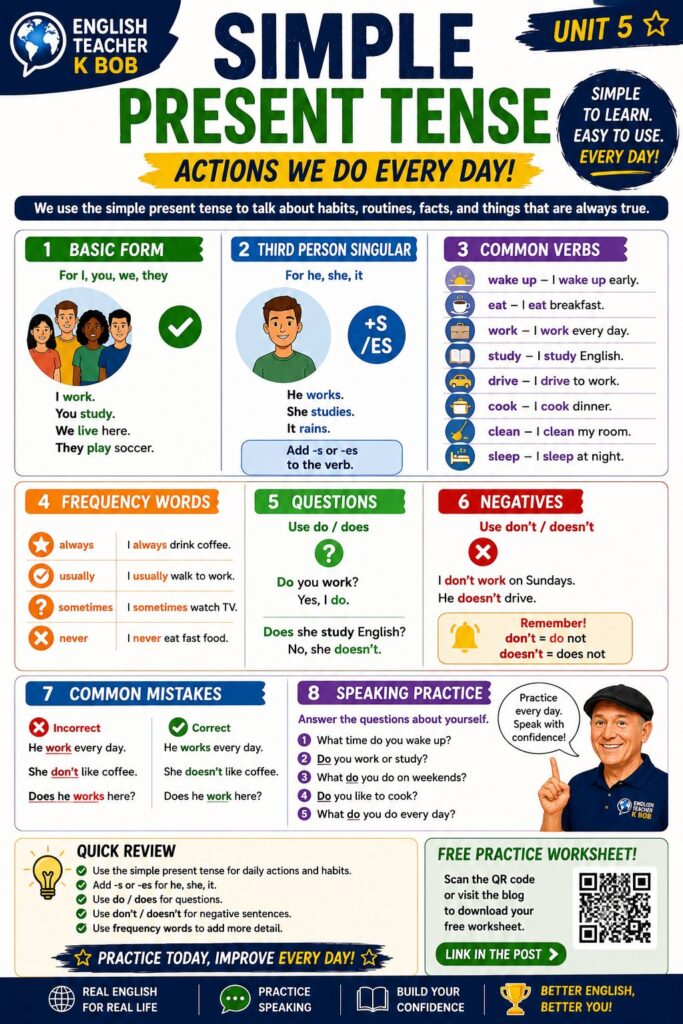
Common Mistakes
| Incorrect | Correct |
| He work every day. | He works every day. |
| Does she works here? | Does she work here? |
| They doesn’t study. | They don’t study. |
| She go to work early. | She goes to work early. |
Speaking Practice
Answer these questions aloud.
- What time do you wake up?
- Do you drink coffee?
- Does someone in your family cook dinner?
- What do you do every day?
- Do you study English at home?
Free Worksheet
Your Turn
Write:
- three daily routine sentences
- two questions
- two negative sentences
- one sentence using always
- one sentence using never
Get the Complete Lesson
Want the full lesson with:
- printable and fillable PDFs
- teacher answer key
- picture dictionary
- infographic
- speaking activities
- role-plays
- grammar charts
- dictation
- review quiz
Visit The KBob Teacher Toolbox:
https://www.teacherspayteachers.com/store/the-kbob-teacher-toolbox
Final Thoughts
The simple present tense helps students talk about real life.
Once students can describe:
- routines
- habits
- schedules
- work
- daily activities
They begin using English in a much more natural way.
This is one of the most important foundations for everyday communication.
What Do You Think?
Which part of the simple present tense is hardest for you or your students?
- third person singular?
- questions?
- negatives?
- frequency words?
Leave comments and questions in the space below. I’d love to hear from you.
Write a sentence in the comments using the simple present.
I always reply.
ESL, #LearnEnglish, #EnglishGrammar, #AdultESL, #SimplePresentTense
This lesson explains the simple present tense in a way that actually feels useful for real life instead of just grammar rules. As not native English speaker I still sometimes forget the “s” with he and she when writing fast, so the common mistakes section was helpful. Do beginner students usually learn daily routine verbs faster when they practice speaking out loud every day? Also, do you think frequency words like “rarely” and “usually” are harder for ESL students than regular verbs? I think the examples about routines and work make the lesson easier to understand because they sound like real conversations people actually use.
Hi Boris, welcome back. Thanks for your comments. I think students learn better by saying everything they learn out loud, as much as possible. To really fully learn and understand just about anything, it needs to become a part of us. I try to keep all lessons as close to real-life as possible for that reason. I don’t know if I’d say frequency words (adverbs) are any more difficult to learn than verbs. From my perspective, students seem to enjoy learning them and being able to use them. I use lots of frequency words in my everyday speaking and teaching. They ask me what they mean and it makes for good class discussion that allows me to ask questions that they can personalize. For example, “how often do you…” etc.
KBob
Hello Bob, thank you for sharing this. Sometimes when speaking English, you do not realize how important the simple present tense is, especially with irregular verbs. I remember always forgetting that words like “study” change to “studies” in the third person. Your explanations and examples made the lesson much easier to understand, and I think this article will be very helpful for ESL students trying to improve their grammar skills.
Do you find that students struggle more with irregular verbs than with normal verb forms?
My sentence is ” I eat lunch every day at work.”
Hi Monica, welcome back. Thanks again for your comments. Yes, ESL students have a tough time with irregular verbs. It reaffirms my #1 rule-English is a crazy language. As for changing y to ies in the third person, that’s only for it, he, and she. They study. The sentence you wrote is perfect. 🙂
KBob