

Learn how speaking, listening, reading, writing, vocabulary, and pronunciation work together to help you learn English faster.

Guess what? When you click and buy through our links, you’re doing more than improving your game. You’re supporting us in a way that doesn’t cost you extra but helps us keep bringing you the best drills and tips. It’s a slam dunk for both of us!
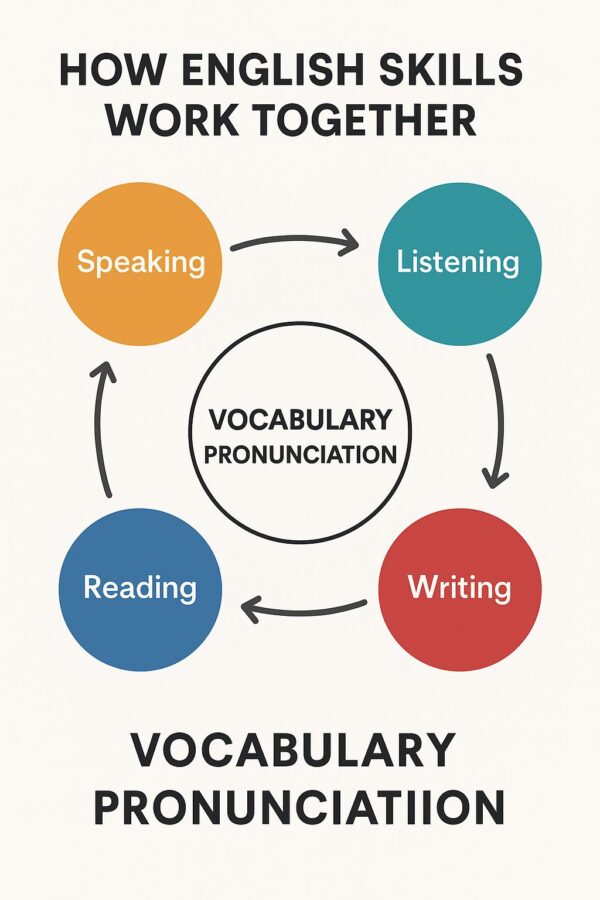
If you want to improve your English quickly and confidently, the secret is simple: use all four skills together—speaking, listening, reading, writing—every single day. When you combine these with vocabulary building and pronunciation practice, you create a powerful routine that helps you understand English, communicate clearly, and remember what you learn.
This post is for adult ESL students, teachers, and businesses who want a complete, practical explanation of how English is best learned.
Summary
- English is learned faster when all four skills are connected.
- Vocabulary and pronunciation strengthen every skill.
- Small daily habits make more progress than occasional big effort.
- Speaking + listening build fluency.
- Reading + writing build accuracy and confidence.
- A downloadable worksheet and TPT lesson are included.
Table of Contents
- How do the four skills work together?
- Why are speaking and listening the foundation?
- Why does reading make everything easier?
- How does writing help you remember English?
- Why are vocabulary and pronunciation essential?
- What simple routine can improve your English every day?
- Free worksheet
- TPT lesson connection
- Final thoughts
How do the four skills work together to help you learn English faster?
The fastest way to improve English is to practice speaking, listening, reading, and writing together every day.
All four skills—speaking, listening, reading, and writing—support each other in my class and all English classes. When you practice them together, your learning becomes automatic. For example, new vocabulary learned from reading becomes easier to use in speaking. Listening helps you improve pronunciation. Writing helps you remember and internalize grammar.
Why are speaking and listening the foundation?
Speaking and listening are real communication. They push your brain to think in English, not translate. Listening gives you the sounds, rhythms, and pronunciation patterns of the language, and speaking helps you use them.
As a teacher, I do a lot of speaking and it’s important that students listen but it’s also important that they listen to and speak with each other.
I try to build speaking and listening into all my lessons.
The best way to learn to speak English is to speak as often as you can.
If you want to say something to me, you can say it in the comments.
If you want 1-on-1 speaking practice, italki offers affordable tutors: https://www.italki.com/affshare?ref=af26596988
Why does reading make everything easier?
Reading gives you exposure to new vocabulary, grammar patterns, and sentence structure. It also increases comprehension and confidence. A great place to start is the Beginner ESL Lessons page, which introduces simple texts for daily reading practice.
Reading gives you vocabulary, sentence patterns, and grammar in context. It exposes you to English that is slightly above your current level—a perfect place for growth.
I begin almost all lessons in my class with a picture dictionary and a workbook that is connected to the picture dictionary.
It not only helps my students develop their vocabulary, it helps them to read as well.
My students usually conclude the picture dictionary lesson by writing sentences about the words they learn from the picture dictionary lesson
I then have students read aloud what they’ve written to help them with their pronunciation to better understand the words and terms they learned in the lesson.
For guided listening + reading practice, EnglishClass101 is excellent: https://www.englishclass101.com/member/go.php?r=4904301&l=%2F
How does writing help you remember English?
Writing forces your brain to organize information. When you write sentences, messages, or short paragraphs, you repeat what you learned in a deeper way, improving memory and accuracy.
I believe there is learning to write and writing to learn. I spend a lot of time teaching my students to write. On the other hand, once students have learned how to write, whether they realize it or not, the writing they do is teaching them in a way they may not realize.
When students write, they are quietly speaking to themselves. So, the writing helps them deepen their understanding of the vocabulary they are learning but it also helps them learn to speak.
In the end, I believe people should be able write the way the speak and speak the way they write.
Why are vocabulary and pronunciation essential?
Vocabulary is the building block of all communication. Pronunciation makes your communication clear. Together, they determine how well you understand and how well others understand you.
I have students who write well and have a good vocabulary but their pronunciation is either hard to understand or completely not understandable at all.
So, they know what they mean and what they are trying to say but if no one can understand what they’re saying, they’re not really saying what they mean to say, at least that’s how the person who’s trying to listen to them thinks.
By expanding vocabulary it allows the student to be more clear about what they are saying. But, in order to be understood, the pronunciation must be acceptable.
For vocabulary-building and structured practice, Mondly is a great tool: https://www.kqzyfj.com/click-100992175-14103335
What simple routine can improve your English every day?
| Skill | 1-Minute Activity | 5-Minute Activity |
|---|---|---|
| Speaking | Say 3 sentences about your day | Record yourself speaking |
| Listening | Listen to a short clip | Listen and write 3 key words |
| Reading | Read a sign or message | Read a short article |
| Writing | Write 1 sentence | Write a short paragraph |
Here is a routine you can complete in 15–20 minutes:
- Read for 3 minutes
- Write 2 sentences about what you read
- Listen to a short clip
- Speak out loud for 1–2 minutes
- Review 5 new vocabulary words
Consistency builds fluency naturally.
If you prefer structured lessons, Rocket Languages provides guided practice: https://f0b91ha8qrkjpi5d26v748ilru.hop.clickbank.net/
Free Worksheet
Download the sample worksheet below.
TPT Lesson Connection
This blogpost connects to the full lesson here: https://www.teacherspayteachers.com/Product/4-Skills-ESL-Lesson-Speaking-Listening-Reading-Writing-16136271
Final Thoughts
The fastest way to improve English is simple: use all four skills together every day. Even small moments of practice build confidence and fluency over time. You don’t need perfection. You need consistency.
What Do You Think?
Has this been helpful for you? Did I leave anything out that would make this more helpful?
What is the hardest skill for you—speaking, listening, reading, or writing? Tell me in the comments.
Call to Action
Ready to improve faster?
- Visit the Study Buddy Project
- Download the free worksheet
- Get the full TPT lesson
- Explore the Resource Library
#ESL, #LearnEnglish, #EnglishPractice
This totally makes sense. I have always been a visual learner, need to see it to fully grasp it. When learning a new language we generally focus on speaking and listening; but it seems so obvious to fully immerse yourself and try to dive into it all at once. Writing is especially intimidating, trying to form new words into coherent sentences; but can really help you develop your vocabulary. the key is to be consistent and practice everyday, totally jump in and stay with it.
Hi John, thanks for your comments. What you said is true when learning just about anything.
KBob
Thank you for sharing this informative article about improving English quickly through the four key skills: speaking, listening, reading, and writing. I found the topic very helpful, especially because many learners struggle with balancing all four skills while trying to become fluent. The idea of improving English faster by working on each skill consistently is very practical.
I do have a few questions after reading the article. What is the best way for beginners to decide which of the four skills to focus on first? Also, how much time per day should someone realistically spend on each skill to see noticeable improvement in a short period?
Another question I had is whether it is more effective to practice all four skills every day or focus on one skill at a time until it improves. Do you think mixing all skills together helps faster progress, or does it slow down learning for beginners?
From my experience, consistent daily practice makes a big difference, even if it’s just small activities like listening to English audio, reading short texts, or speaking simple sentences out loud. I’ve also noticed that writing regularly helps me remember vocabulary better and improves confidence over time.
I think the article gives a strong and realistic approach to learning English faster by developing all four skills together. Thank you again for sharing these useful tips and strategies.
Hi Iyere, thanks again for your comments. You pose age-old questions that you have pretty much answered in your comments. First of all, there is no one-size-fits-all when it comes to learning English or really, when it comes to learning anything. People are different and we all respond to things differently. The real question is, what’s best for us as individuals? No one can answer that but ourselves.
A major part of learning anything, particularly a new language, is to know ourselves well enough to know what our strengths and weaknesses are. Our greatest weakness is where we need to spend the most time learning and practicing. Our greatest strength needs to be the tool that helps us with our greatest weakness. I hope that makes sense. In other words, we need to prioritize in our own minds how and where to direct our energies. Meanwhile, all four skills are important and constant attention and practice is necessary to all aspects. It’s more an art than a science.
As a teacher, I’m confronted with countless personalities with countless situations, backgrounds, strengths and weaknesses. It’s impossible for me to know what’s best for everyone, especially in the beginning. I share my own experiences, strengths, and hopes while allowing myself to be vulnerable enough to know what my own weaknesses are.
The bottom line is, we must be vigilant and allow ourselves whatever time it takes. It’s better to spend five minutes a day, every day, practicing what we need the most help with, than it is to spend long periods of time every once in a while. We need to know ourselves and our limits. It seems to me, you’ve done that and are doing that. Keep doing it if it works. If it doesn’t work, you’ll need to adjust.
KBob