

Learn how to ask better questions in English using who, what, where, when, why, and how. Simple ESL speaking tips.

Guess what? When you click and buy through our links, you’re doing more than improving your game. You’re supporting us in a way that doesn’t cost you extra but helps us keep bringing you the best drills and tips. It’s a slam dunk for both of us!
If you want to improve your English speaking skills, one of the most powerful things you can do is learn how to ask better questions. Asking questions helps you start conversations, keep them going, and understand others more clearly.
Summary
- Asking questions improves speaking quickly
- Question words are the foundation of conversation
- Practice builds confidence and fluency
- A structured lesson and worksheet are included
Table of Contents
- How can you ask better questions in English?
- Why are questions important for speaking?
- What are the most important question words?
- How can you practice asking questions daily?
- Free worksheet
- TPT lesson connection
- Final thoughts
How can you ask better questions in English?
The best way to ask better questions in English is to use question words like who, what, where, when, why, and how, and practice them in real conversations every day.
Why are questions important for speaking?
Questions are the foundation of real communication. When you ask questions, you are not just practicing English—you are interacting with another person.
In my classroom, I encourage students to ask questions constantly. When students ask questions, they:
- Speak more
- Listen more carefully
- Build confidence
- Learn faster
The more questions you ask, the more opportunities you have to use English in a natural way.
If you want more speaking practice with real people, platforms like italki offer affordable one-on-one lessons with tutors from around the world. It’s a great way to practice asking and answering questions in real conversations.
What are the most important question words?
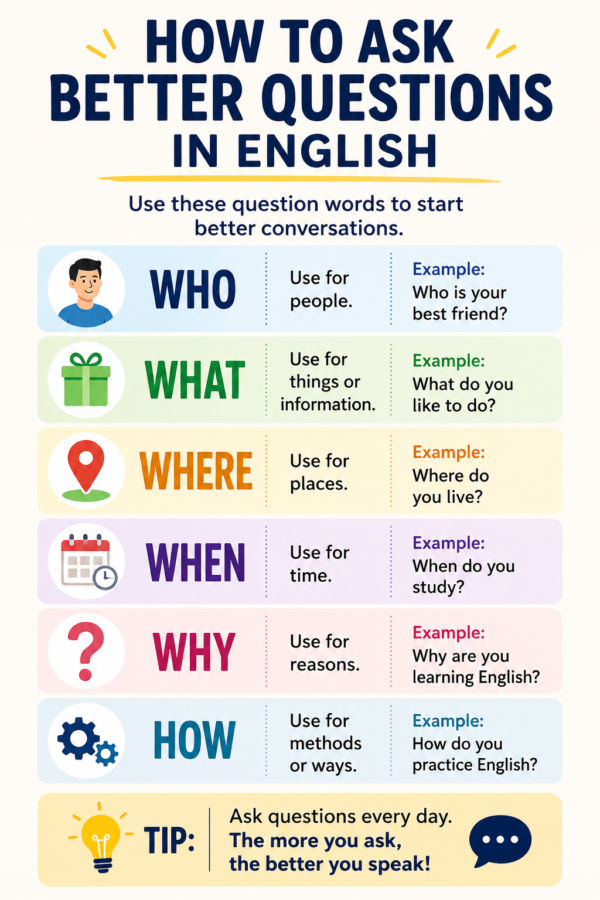
These six words are essential for asking questions in English:
| Question Word | Meaning | Example |
|---|---|---|
| Who | Person | Who is your teacher? |
| What | Thing | What do you do? |
| Where | Place | Where do you live? |
| When | Time | When do you study? |
| Why | Reason | Why do you learn English? |
| How | Method | How do you practice English? |
These words help you create meaningful questions and understand conversations better.
How can you practice asking questions daily?
You do not need hours of study. You just need consistent practice.
Simple Routine (10–15 minutes)
Do this every day
- Ask 3 questions to a classmate or friend
- Answer 3 questions
- Ask one follow-up question
- Practice with 2–3 different people
Example:
- Where do you live?
- What do you do?
- Why are you learning English?
Then ask:
- Why?
- Can you explain?
- Tell me more
This is exactly how real conversations work.
If you prefer a guided learning path, Rocket Languages offers step-by-step lessons that reinforce speaking, listening, and question-building skills.
Free Worksheet
Download the sample worksheet below to practice asking questions.
TPT Lesson Connection
This blogpost connects to the full lesson:
Download The Complete Lesson Now
Final Thoughts
If you want to improve your English speaking skills, start asking better questions.
You do not need perfect grammar. You do not need long conversations.
You just need to start asking—and keep asking.
What do you think?
Which question word is hardest for you to use?
Tell me in the comments.
I’d love to hear from you.
I always reply.
For additional vocabulary and daily practice, apps like Mondly can help reinforce question patterns and common conversation skills.
Call to Action
Ready to improve faster?
- Download the free worksheet
- Get the full lesson on TPT
- Join the Study Buddy Project
#ESL, #LearnEnglish, #EnglishSpeaking
What a great suggestion for learning a new language. It’s always best to ask questions, and I see how it could be the best way to learn. even if you don’t understand the answer, that just opens you up for follow up questions or discussion. I feel like “Why” is the go-to question, but make sure to be specific about what you really need to know.
Hi John. Welcome back. Thanks again for your comments. Although it’s important that students clearly understand how and when to use each of the WH questions, I think you’re right. In the end, understanding the WHY of most anything helps everything else fall into place.
KBob
This is a very practical and encouraging approach to improving English speaking skills, especially for learners who struggle with confidence in conversations. I like how you simplified the process by focusing on question words and daily interaction rather than overwhelming students with grammar rules. The structured practice routine and follow-up question examples reflect how real conversations naturally develop, which makes the learning process more engaging and effective. Including worksheets, guided lessons, and speaking platforms also adds valuable support for learners who want consistent practice and long-term improvement.
Hi Kavitha, welcome back. Thanks again for your comments. I do my best to make lessons as practical as possible so that they can use what they learn in my class in their real lives immediately. They may not always know what it’s called but, there’s a good chance they know how to use what they learn.
KBob